Cape Cod Guide
Here's a guide to Cape Cod, its beaches, parks & nature reserves, music & theater, historic monuments, and museums in the towns of Barnstable, Brewster, Chatham, Dennis, Eastham, Falmouth, Harwich, Hyannis, Orleans, Provincetown, Sandwich, Truro, Wellfleet, Woods Hole and Yarmouth.
Cape Cod Beaches
Cape Cod has lots to see and do, but few come to the Cape without enjoying its wonderful beaches.
The Nantucket Sound beaches along the southern shore and Atlantic beaches up the eastern shore (including the Cape Cod National Seashore) offer broad swaths of sand, cool to chill water temperatures and, in some places, good surfing.
Beaches along the Cape's northern and western shores, facing Cape Cod Bay, are less eye-catching but usually great for families and those who prefer warmer water temperatures, less surf, and smaller crowds.
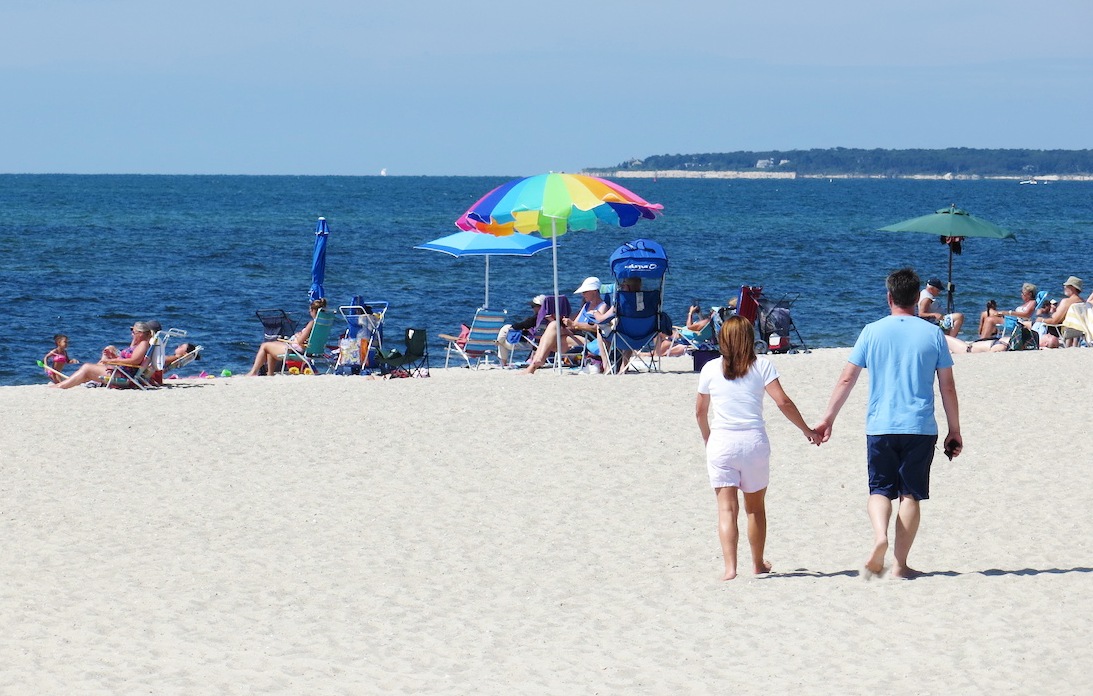
Bass River Beach, South Yarmouth, Cape Cod...
Cape Cod even has freshwater beaches on a number of its glacial ponds.
Cape Cod's Pretty Towns
Although it is among New England's most popular vacation destinations, Cape Cod is not a modern resort region—it has been inhabited for millennia! The first European settlers arrived in the 1630s, and most of its towns boast historic houses, churches, cemeteries and other monuments to the centuries. In short, it's long on Old New England charm.
Sandwich
Sandwich calls itself "the prettiest town on Cape Cod." It's certainly the oldest, and has the fine museums and historic houses to prove it. More...
Falmouth
Falmouth, with its picture-perfect New England village green, fine old Town Hall, library and other public buildings, has a dignity and class that's in pleasant contrast to the more commercial beach resorts. More...
Chatham
Chatham, filled with graceful old trees, fine mansions, palatial inns, and a sturdy lighthouse, is perhaps the most refined of the Cape's major resort towns, drawing visitors from around the country, the continent, and the world. More...
Provincetown
Provincetown, with lots of sand and beach, gaudy Commercial Street strolling and shopping, whole neighborhoods of cozy inns, a vibrant LGBTQ+ scene, hides its history a bit, but this is where the Pilgrims first set foot in the New World, as the lofty Pilgrims Monument proclaims. More...
Parks & Nature Reserves
Cape Cod is a glacial landscape, mostly forested, of broad beaches, numerous glacial ponds, and a few rocky outcrops. Extending into the Atlantic Ocean, it's a stopping-place for birds, whales, seals and other wildlife.
Cape Cod National Seashore
Cape Cod National Seashore, besides its popular beaches, has miles of hiking and bike trails and many wildlife reserves and observation areas. More...
Nickerson State Park
Nickerson State Park in the Cape Cod town of Brewster is 1900 acres (769 hectares) of forest with eight glacial ponds, fresh- and salt-water beaches, hiking and biking trails, and 400 camping places. More...
Monomoy National Wildlife Refuge
Monomoy National Wildlife Refuge, eight miles (13 km) of low sand islands off the Cape Cod coast south of Chatham, is a favored stopping-place for migratory birds. Tours can be arranged by boat. More...
Cape Cod Museum of Natural History
Cape Cod Museum of Natural History, in Brewster, is the answer to the question "Where do we look for nature on an inclement day?" On fair days, the museum and its aquarium has its own outdoor nature walks to enjoy along with the indoor exhibits. More...
Music & Theater
Provincetown Theater, an old-time favorite, is active all summer.
Cape Cod Melody Tent in Hyannis features top-name popular vocalists in concert.
Cape Playhouse in Dennis has famous actors in timely productions.
Cape Rep in Brewster has semi-pro productions of high quality.
Monomoy Theater in Chatham, with a stock company from Ohio University.
Historic Monuments
Pilgrim Monument, Provincetown, near where the Pilgrims first stepped on American soil.
French Cable Station Museum, Orleans, where the first transatlantic telephone cable came ashore.
Marconi Station site, near South Wellfleet, where the great Italian physicist established a transatlantic wireless station in 1902.
Museums
Heritage Museums & Gardens, a 76-acre estate in Sandwich with outstanding collections of Americana.
John F Kennedy Hyannis Museum, a small tribute collection to the late president in Hyannis.
Provincetown Museum, in the Pilgrim Monument, Provincetown, n
Sandwich Glass Museum, where the town's renowned glass industry lives on.
Cape Cod Hotels, Inns & Resorts
You need reservations well in advance if you want to get the right lodgings on Cape Cod in summer. Don't delay! Here are the details.
Cape Cod Transportation
Cape Cod and many of its best places are accessible by public transportation: planes, trains, buses, ferries and bikes. Here are all the details.
Barnstable MA
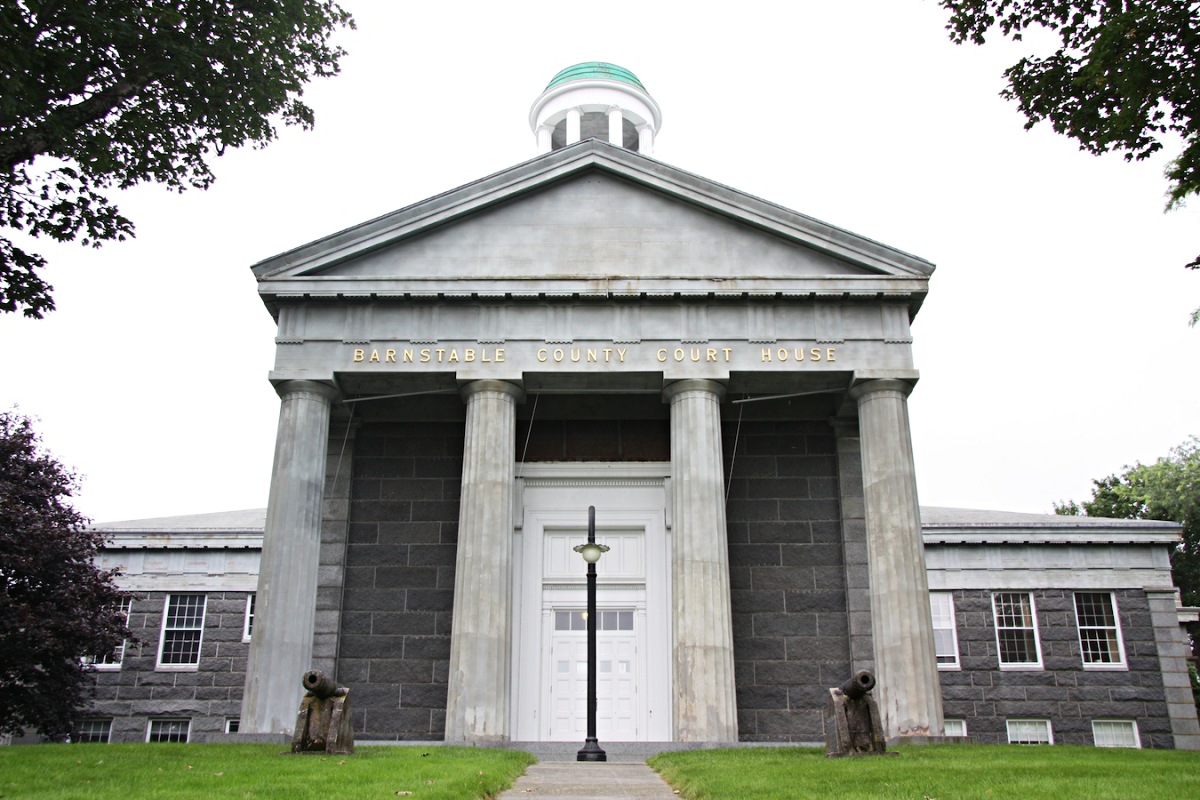
Barnstable County Courthouse, Barnstable, Cape Cod MA.
Most visitors to Cape Cod think of Hyannis as the largest town, but in fact Hyannis is only one of the seven "villages" in the incorporated Town of Barnstable. The villages are: Barnstable, Centerville, Cotuit, Hyannis, Marstons Mills, Osterville and West Barnstable.
Barnstable Town's administrative center is not Hyannis, on the southern, Nantucket Sound side of Cape Cod, but Barnstable Village, on MA Route 6A on the northern, Cape Cod Bay side (map).
Here you'll find the Doric-temple Barnstable County Courthouse and other important county and town government offices, as well as a statue of patriot James Otis (1725-1783).
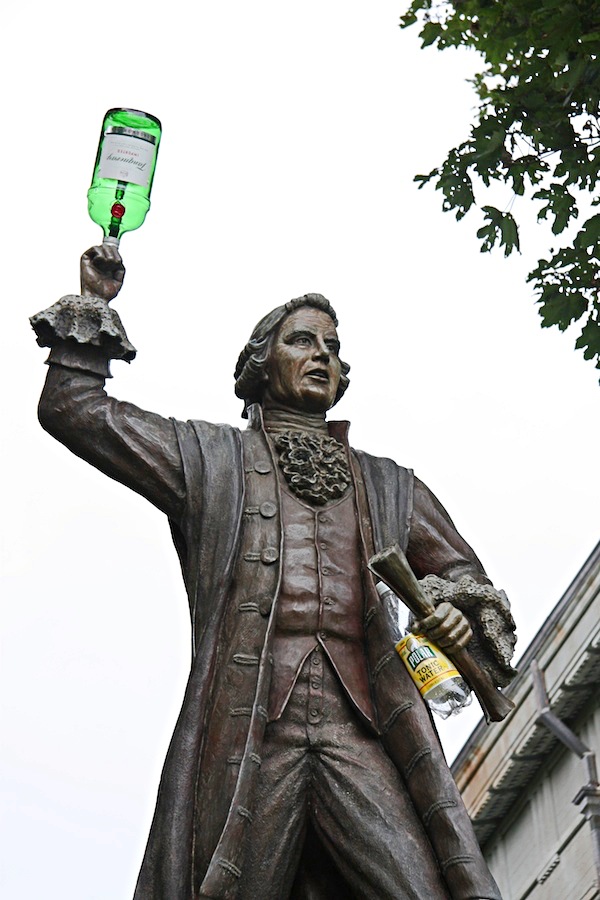
Revolutionary patriot James Otis of West Barnstable advocating
for gin & tonic...
The busy commercial center of Hyannis is the closest thing to a city on Cape Cod, with alll the expected services, including the Cape Cod Gateway Airport (HYA), fomerly known as the Barnstable Municipal Airport or Hyannis Airport, and docks for ferryboats to Nantucket.
Barnstable Village has one of Cape Cod's best beaches: Sandy Neck Beach, facing the warmer waters of Cape Cod Bay. More...
Brewster MA
A country store, several fine churches, and a Town Hall make it look like many other pleasant Cape Cod towns, but Nickerson State Park makes it different.
Brewster is one of the picturesque little towns on the north shore of Cape Cod along MA Route 6A facing Cape Cod Bay (map) with several seaside resorts, hotels, motel and inns, not to mention the 400 campsites in Nickerson State Park, and a number of cultural institutions.
Nickerson State Park
Wholly within the boundaries of the town of Brewster, the 1900-acre (769-hectare) Roland C Nickerson State Park is a Cape Cod anomaly: a non-commercial forested nature and recreational reserve boasting eight freshwater glacial kettle ponds.
With its 400 campsites and yurts, the park is the premier natural lodging-place on Cape Cod. The campsites can be reserved up to six months in advance, and many of those in Nickerson State Park are reserved well in advance.
Besides camping, Nickerson State Park offers fresh-water and salt-water beaches and swimming, bike paths and mountain biking, bird-watching, boating, canoeing, fishing, walking and hiking, and many of these activities are accessible to the handicapped.
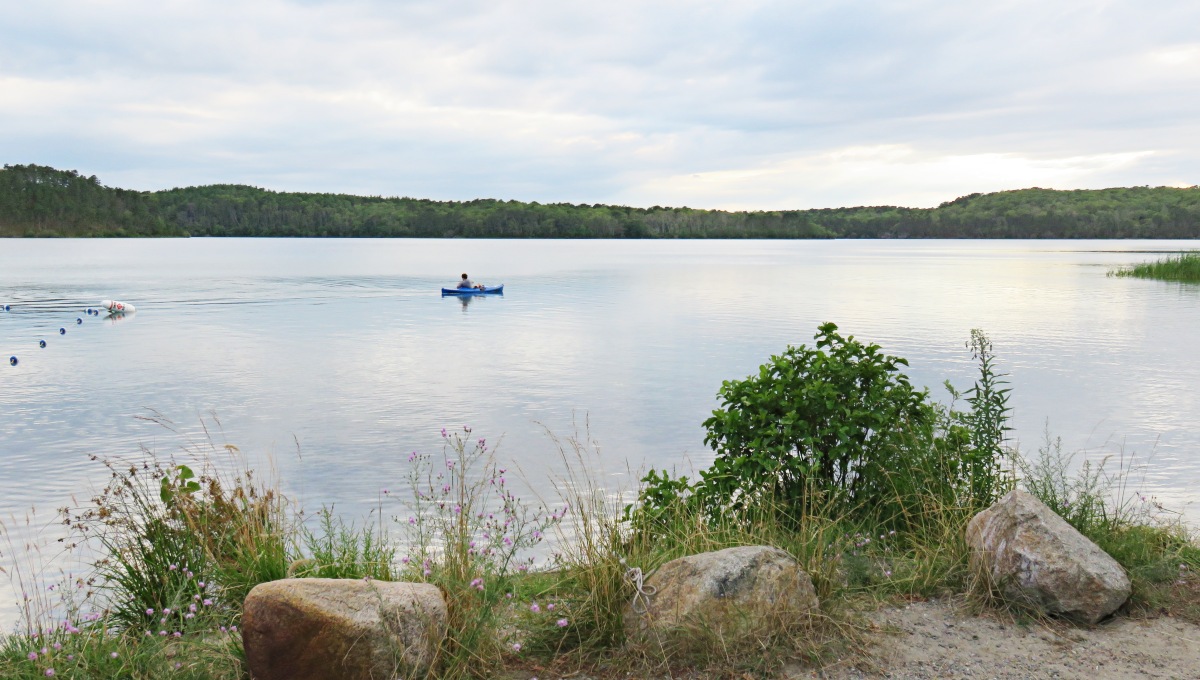
Peaceful evening scene at Cliff Pond in Nickerson State Park...
No camping places available? Try Sweetwater Forest, a private campground in Brewster, or the Dunes' Edge Campground in Provincetown.
Stony Brook Grist Mill & Museum
Brewster is proud of its historic grist mill and herring run on Stony Brook Road near the intersection with Satucket and Run Hill roads. The 19th-century mill is now part of a park owned by the town of Brewster.
The waterwheel, still in good working order, powers the grinding machinery inside the mill. You can watch the whole process at work, and buy freshly ground cornmeal, from 2 to 5 pm on Wednesday, Friday, and Saturday afternoons in July and August.
Upstairs there's a small museum with artifacts from the "Factory Village" which occupied this site over 100 years ago.
Wander around the millpond, certainly one of the most romantic and picturesque locales on all of Cape Cod. If your visit falls during mid-April to early May, watch for the run of alewives (herring) which surges upstream from the ocean to freshwater spawning grounds. More...
Cape Rep Theatre
Hidden away off MA Route 6A, the Cape Rep offers high-quality semi-pro theater in the summer months. More...
Cape Cod Museum of Natural History
Those interested in Cape Cod's flora, fauna, and ecology will want to visit the Cape Cod Museum of Natural History, 869 Route 6A (tel 508-896-3867).
The museum organization was founded in 1954 to preserve the wildlife and plant life in the area around Stony Brook and its marshes, to study this land, and to teach others about it.
Nature walks, a lecture program, and children's classes are held year round. In summer museum naturalists lead trips to Monomoy Island to observe birds and wildlife. More...
Chatham MA
Chatham was once the railhead for Cape Cod, and the trains that took fish, salt, and shoes out also brought vacationers in—another opportunity for wealth.
Chatham got rich, and is still a graceful town of big old houses and inns, an easy pace, friendly people, and pleasant vistas all around (map).
Visitors come to look at Chatham Light, the town's beaches, its resort hotels, and its inns full of character. You'll find Chatham an active, bustling place in July, August and September, with lots of traffic and few streetside parking spaces, though town parking lots off Main Street provide relief.
Chatham Light
Go east on Main Street and turn right (south) on Shore Road to the lighthouse, right next to the Coast Guard Station (map). On the other side of the street is a place to park while you look at the view through some pay telescopes, and down below, a fine beach. The first lighthouse was erected on this point of land in 1808. The present lighthouse dates from 1878.
The view is pleasant, looking out to sea across Lighthouse and Nauset Beach (the sand bar, actually a peninsula, you see out in the water). The cool sea breeze in summer and the nautical blast in winter make it incredible to think that Rome, Italy is at almost exactly the same latitude as Chatham—but 4,200 miles/6775 km to the east.
Fish Pier
Follow Main Street east to Shore Street, then go left (north) to reach the Fish Pier (map), operated by the town for licensed Chatham fishing boats.
Chatham is proud of its fishing fleet of small boats, which the townspeople boast brings in the freshest fish. The use of little boats means the catch is brought in every day. Larger boats stay out to sea for days, refrigerating their catch on board.
Pier Hosts, often retired fishers, are on hand Friday, Saturday and Sunday between 10 am and 1 pm, from Memorial Day through Labor Day, to explain the workings of the boats, the pier, and the livelihood of ocean fishing. It's a program of the Cape Cod Commercial Fishermen's Alliance. More...
From mid-morning until afternoon, you may see boats of the fleet come in and unload. You can buy the day's catch right there.
Rent a boat at Fish Pier for a day's hunting for bass, bluefish, and tuna out at sea. Or simply buy it fresh from the Chatham Pier Fish Market, right there by the dock. They'll cook you a fine lnch of fish seafood, also.
Chatham Beaches
The town of Chatham has wonderful public beaches (fee payable), many of them barrier beaches backed by warm-water lagoons.
Oyster Pond Beach
Oyster Pond Beach is only a few blocks from the center of town south on State Harbor Road from Main Street, with warm, calm waters, fine views, picnic tables, and a swimmer's raft.
Lighthouse Beach
Chatham's largest beach is Lighthouse Beach, only a half-mile (800 meters) from the center of town. Splendid as it is, it has some strong currents and no lifeguards.
Harding's Beach
Harding's Beach, on calmer Nantucket Sound in West Chatham, is the most family-friendly of Chatham's beaches, with lifeguards, bathhouses for changing and showering, and food trucks for sustinence. Follow Main Street (Route 28) west from the center of town for about 2 miles, and turn left (south) on Barn Hill Road to Harding's Beach Road.
Nearby Cockle Cove is best for the smallest kids, with shallow warm-water wading and splashing areas. Ridgevale Beach, also nearby, is similar to Harding's.
Pleasant Bay (Jackknife) Beach
Pleasant Bay (Jackknife) Beach, near the Harwich town line in North Chatham, is another good choice for families, a sheltered cove with warm, shallow water. No lifeguards or toilets, but no admission fee either. Pleasant Street Beach in South Chatham is similar.
For Chatham Residents Only
Schoolhouse Pond Beach is for Chatham residents only, and Forest Beach is mostly used by local property owners.
Chatham's Godfrey Grist Mill
On a hilltop by Shattuck Place in Chase Park less than 10 minutes' walk south of Chatham Town Hall stands the Godfrey Grist Mill, built in 1797 and recently restored to working condition—meaning it even grinds grain! the interior is only limited hours in July and August, but you can admire it from the outside anytime. To find it, take Cross Street south off Main Street to Shattuck Place, which winds down to the mill (map). More...
Bird & Wildlife Sanctuary
Chatham is a particularly good place for seeing birds. Monomoy National Wildlife Refuge, on Monomoy Island, south of the town, has been a refuge since 1970. Over 300 species of birds have been spotted on its 7600 acres (31 square kilometers).
May is the best time to see birds in their mating plumage, and starting in late July many birds begin to be seen in winter plumage.
The only way to get to Monomoy is by boat from Chatham. The Monomoy Island Ferry is the easiest way, offering South Monomoy Island walking tours as well as transportation. More...
Some areas of Monomoy are off-limits to visitors during nesting season. Details on current possibilities for Monomoy visits are available from the town's information booth.
Band Concerts
One of the nicest things about Chatham in July and August is the schedule of band concerts (every Friday evening at 8 pm) in Kate Gould Park, just past the Chatham Wayside Inn on Main Street (map).
Everybody comes to the concerts, and on a typical Friday evening the crowd may reach into the thousands. Most of the musicians in the town band are year-round residents of Chatham who live and work in the town and enjoy providing a little free entertainment for their fellow citizens and visitors once a week.
Monomoy Theatre
The Monomoy Theatre, 776 Main Street (tel. 508-945-1589), not far west of the intersection with Old Harbor Road, is the summer-stock operation of Ohio University and offers a different play each week from mid-June through August. More...
Museums & Historic Houses
Chatham has its share of antique buildings open to the public, each highlighting a part of the town's interesting past.
The Atwood House Museum (tel 508-945-2493), 347 Stage Harbor Road, is run by the Chatham Historical Society and feature over 2,000 exhibits, including an outstanding shell collection, a good number of pieces of Sandwich glass, and a crewel bedspread which took townspeople six years to make.
Also on display is a set of French lighthouse lenses used in the Chatham Light from 1923 until recently.
The Chatham Railroad Museum is located in the old station 153 Depot Road (take Old Harbor Road north off Main Street, and Depot Street is a short distance up on the left).
The station was built in 1887 by the Chatham Railroad Company and was turned into a museum in 1960. Among the railroading exhibits is a completely restored 1910 wooden caboose, used by the New York Central until that company gave it to the museum.
Dennis MA
In the Cape Cod town of Dennis, it is claimed, the commercial cranberry-harvesting industry began, and salt works flourished. Today, visitors come for its splendid beaches and numerous hotels, motels and inns in all price ranges. Music, drama, scenic beauty, and of course more than a dozen beaches keep residents and visitors happy in Dennis.
Beaches
Over a dozen beaches, on the northern Cape Cod Bay shore, the southern Nantucket Sound shore, and on freshwater Scargo Lake, keep both visitors and residents happy in Dennis. The eastward continuation of Yarmouth's beaches are in West Dennis and Dennis Port—and fine beaches they are!
During the summer season, visitors to Town of Dennis beaches arriving by car without a Town of Dennis resident sticker must pay a daily parking fee. If you walk or bike to the beach, no fee is collected.
Here are Dennis's beaches, from west to east and north to south:
Cape Cod Bay Beaches
On the Northside (as it's called in Dennis), there are five beaches open to th public and three reserved for Town of Dennis residents and renters.
Chapin Memorial Beach
A track for 4-wheel-drive vehicles and toilets are the services at this beach at the western end of Dennis's northern Cape Cod Bay shore.
Mayflower Beach
West of Corporation Beach, Mayflower Beach is open to all, with showers, toilets, food stands and handicapped access, while neighboring Bayview Beach is open to Dennis residents only.
Corporation Beach & Howes Street Beach
This beach in the center of Dennis's north shore facing Cape Cod Bay has two entrances, thus its two names. Services include toilets, showers, a playground, food stands, and handicapped access.
Sea Street Beach
Sea Street Beach, near the eastern end of Dennis's Cape Cod Bay shore, is open to all, and has toilets, while Harborview and Cold Storage beaches to the west of it are open to Dennis residents only.
Scargo Lake Beaches
Two beaches on freshwater Scargo Lake near the northern shore of Dennis are open to all visitors:
Scargo Beach
On the southeastern shore of the lake, this small frshwater beach near Scargo Hill Tower has Hhandicapped access and toilets.
Princess Beach
Princess Beach, at the northeastern corner of the lake, has a picnic area and toilets.
Nantucket Sound Beaches
Here are the beaches along the Southside, Dennis's southern Nantucket Sound shore from west to east.
West Dennis Beach
Reached via School Street, three-mile-long West Dennis Beach is among the town's finest, a broad beach with a bathhouse, showers and toilets, snack bar, 1300 parking spaces in separate lots for visitors and residents, and the 3-star, 68-room Lighthouse Inn.
South Village Beach
At the southern end of Swan Village Road, South Village Beach has toilets, and separate parking lots for residents and non-residents. Haigis Beach, to the east of South Village, is for residents only.
Glendon Road Beach
Off Old Wharf Road, Glendon has showers and toilets.
Sea Street Beach
At the southern end of Sea Street in Dennis Port, this beach has public toilets, and the 3-star, 42-room Pelham House Resort, should you want to spend the night.
Raycroft & Depot Street Beaches
These two small beaches east of Sea Street Beach have no services, nor lifeguards.
Metcalf Memorial Beach
At the eastern end of Dennis's southern shore, off Chase Avenue, Metcalf Beach has public toilets,a nd is backed by several resort hotels. including the 3-star, 76-room Edgewater Resort.
Inman Road Beach, just west of Metcalf, is for Town of Dennis residents only.
Cape Cod Museum of Art
The CCMOA, at 60 Hope Lane (map), featuresart cCollections and exhibitions that concentrate on the art and artists of Cape Cod, and the works that influenced them, including those of Arthur Bauman, Varujan Boghosian, Alexander Calder, Sal Del Deo, Edwin Dickinson, John Joseph Enneking, Joseph Eliot Enneking, R H Ives Gammell, Arnold Geissbuhler, Charles Hawthorne, Robert Henry, Henry Hensche, Hans Hofmann, Robert Douglas Hunter, Hilda Neily, Haynes Ownby, and Selina Trieff. More...
The Cape Playhouse
The Cape Playhouse - Cape Cod Center for the Arts, 820 Main Street (Route 6A) (map), in the northern part of Dennis (map), is the place to go on the Cape if you want to see a famous actor or actress in a well-known play from Broadway and beyond.
The performance season runs from early July through Labor Day, with performances on Monday to Saturday evenings, plus mid-afternoon ("matinee") performances on Wednesday and Thursday.
The playhouse has its own restaurant, open for lunch on matinee days, for dinner Monday through Saturday, for Sunday brunch, and for after-theater snacks.
Also here is the Cape Cinema, designed after the Congregational church in Centerville. The cinema shows first-run movies and boasts a mammoth, 6,400-square-foot mural of the heavens by Rockwell Kent.
Scargo Lake & Hill Tower
This pretty lake with two freshwater beaches, recreation areas, and a lookout tower make a good outing during your time in Dennis.
As you enter the center of Dennis along MA 6A heading east, look for a cemetery and a white church (map). Just past them turn right onto Old Bass River Road and follow signs for eight-tenths of a mile to the Scargo Hill Tower.
Park at the base of this stone structure surrounded by oak and pine, and climb the 36-step steel staircase inside to the top for a view that will tell you what the Cape is all about.
On a clear day you may see Provincetown, at the tip of the Cape, the white blade of the Cape beaches cutting the deep blue of Cape Cod Bay.
The Cape itself appears as a huge green scimitar, a sea of green trees with little white or silver-gray shingled houses (not to mention cylindrical water towers) poking through here and there.
At the foot of the hill that holds the tower is Scargo Lake, ith its two freshwater beaches, and west is the outline of Barnstable Harbor.
The tower was given to the town of Dennis in 1929 by the Tobey family, who had had ancestors living in Dennis since 1678.
As you descend the steel stairs, they chime in bad imitation of a church carillon.
Eastham MA
The Cape Cod town of Eastham's main attractions are a historic windmill, a museum, and the Salt Pond Visitor Center of the Cape Cod National Seashore.
Right across the street from the Salt Pond Visitor Center is the quaint and attractive Eastham Historical Society Museum (map). Look for the curious gateway, made from the jawbones of a huge whale.
The museum, once a schoolhouse, dates from 1869.
Just south of the Salt Pond Visitor Center on other (est) side of US 6 is the oldest windmill on Cape Cod (1793) in a pretty park. It's a favorite place to stop and take a photo, throw a frisbee, or enjoy a picnic.
From the windmill, take a side trip west to First Encounter Beach, where the Pilgrims first met the Indian inhabitants of Cape Cod back in 1620.
A plaque on a boulder up the hill just north of the parking lot commemorates the meeting, which apparently was anything but cordial.
You can visit the boulder plaque for free, but if you want to park and swim and use the beach during the summer, you'll have to pay the town's beach-use parking fee.
Falmouth MA
Falmouth typifies America the Beautiful, and that's no accident: Falmouth resident Katherine Lee Bates wrote the poetic words to this favorite American patriotic hymn.
Falmouth, on Cape Cod (map), is a pretty town that has grown rapidly in recent years but has managed to preserve a lot of the charm of a rural New England community.
A well-preserved village green, magnificent tall shade trees along Main Street, green lawns around the library: Falmouth has an easy grace, and an easy pace despite being a transfer point for travelers going by ferry to Martha's Vineyard.
It's a good-sized town, but the attractive town center is easily walkable. Tall trees make the downtown section attractive, and manicured lawns and white clapboard houses dress up the side streets.
The town has a few pleasant historical inns, several good beaches, and a beautiful old mansion-turned-museum where you can learn about Ms Bates and the writing of "America the Beautiful."
A few miles past Falmouth to the south is Woods Hole, home of world-famous Woods Hole Oceanographic Institute and the Marine Biological Laboratory.
Car ferries depart Woods Hole for Martha's Vineyard several times daily in summer.
Museum
The Falmouth Historical Society has interesting displays pertaining to Falmouth's history in its lovely old mansion, the Julia Wood House, located just off the Village Green at 55-65 Palmer Avenue (tel 508-548-4857).
For the price of admission you also get to see the adjacent Hallett Barn, with displays of early tools and farm implements, and the Historical Society's shop, as well as Conant House, next door, with more historical collections.
The Katharine Lee Bates Room holds memorabilia of Falmouth's poet, who wrote the words to America the Beautiful.
The cordial staff at the Historical Society will be sure to point out that the white Congregational church on the green is equipped with a bell cast by Paul Revere.
Bicycling
A prime Falmouth activity is to rent bicycles and to follow the Shining Sea Bicycle Path down to Woods Hole.
The Bikeways Committee of the Falmouth Chamber of Commerce publishes a bicycling map that shows bike routes and beaches and gives the addresses of shops that rent bicycles. By biking to a beach, you may avoid paying the several dollars for parking, and you can put the money saved toward the bicycle rental fee.
Beaches
Besides bike trips down to Woods Hole, Falmouth's greatest outdoor attraction is its coastline. The Town Beach is down at the end of Shore Street (best to walk, as parking can be a problem). The water can be very chilly except in July and August, but otherwise the beach is fine, and it has a view of Martha's Vineyard in the distance.
The best swimming and sunning spot in the area is Old Silver Beach, several miles northwest of downtown Falmouth. If you have more energy than money, bicycling is the way to go, even though it's a distance. If you drive and pay the parking fee, just consider that the money goes toward keeping the beach clean and safe.
A headland and several jetties set the beach off into sections; the town runs a clam bar which sells sandwiches, fried clams, and soft drinks, and offers changing rooms. The crowd at Old Silver is spirited, young, and sun-hungry.
Band Concerts
The town of Falmouth sponsors free band concerts down at the Falmouth Marina on Thursday evenings during the months of July and August. Try to make it to at least one concert; it's a real old-time event.
Transportation
Falmouth's own m/v Island Queen, Falmouth Heights Road, Falmouth MA 02540 operated by Island Commuter Corp, carries passengers and bicycles only (no cars) from Falmouth Harbor to Oak Bluffs on Martha's Vineyard.
This passenger ferry sails seven times a day in each direction from mid-June through the first week in September.
In early June and mid-September it sails twice a day in each direction during (four times a day on weekends). There are no sailings from late September through May.
The voyage takes about 35 minutes, and is usually quite smooth and comfortable.
A refreshment bar on board serves snacks, sandwiches, soft drinks, beer, and cocktails. You can also buy Martha's Vineyard tour bus tickets on board.
There is even a moonlight cruise on some evenings in July and August.
For car ferries to the islands, you'll have to go to Woods Hole.
Harwich & Harwich Port MA
Pretty Harwich Port is favored by those who own or rent property there.
The Cape Cod town of Harwich, between Dennis to the west, Brewster to the north, and Chatham and Orleans to the east (map), was settled in 1670 and incorporated as a town in 1694.
Today, it is a quiet resort town of private homes, vacation homes, condominiums, and a few hotels.
The town has seven villages: Harwich Center, North Harwich, South Harwich, East Harwich, West Harwich, Harwich Port and Pleasant Lake.
Most of Harwich's beaches are on the south shore on Nantucket Sound. Although the beaches are open to the public, parking at most of them is reserved for permit holders—meaning town residents, so in effect they are pretty well closed to those who do not own or rent property in town.
Harwich Port, the town's main population center, has the town's three small, pretty harbors for private boats: Allen, Saquatucket and Wychmere. Also here are the Harwich Chamber of Commerce and its Information Office, a historic church, cafés, restaurants, and shops.
Hawksnest State Park is here, as is Long Pond, Cape Cod's largest body of fresh water—big enough to be the favored landing-place for sea planes.
Harwich boasts that it is the birthplace of Massachusetts's cranberry industry, having begun to harvest the tart red berries in 1846.
If you're meandering along MA Route 28 between Dennis and Chatham, you may want to stop for a little while in Harwich Port; but if you don't own or rent property there, it has little to hold you.
Hyannis MA
President John F Kennedy made Hyannis famous, and it's still the center of Cape Cod life. It's a good place to stay for explorations of Cape Cod, Nantucket and Martha's Vineyard.
Hyannis, one of the seven "villages" of the Cape Cod Town of Barnstable MA (map), gained national fame during the presidency of John F Kennedy because of his summer home in neighboring Hyannis Port.
In fact, Hyannis has been the center of Cape Cod commerce, transportation and lodging for a long time. It's the cape's largest settlement, with the greatest number of services, including commerce and, especially, hotels and transportation. Hyannis can be a good base for your explorations of the cape.
Getting to Hyannis
Whether you come to Cape Cod by land, sea or air, you'll probably pass through Hyannis. Cape Cod Gateway Airport (HYA), formerly Barnstable Municipal Airport (or Hyannis Airport), is north of the town center, not too far from the Hyannis Transportation Center (bus and train station) and the station for the Cape Cod Central Railroad excursion-train (map).
Ferries to the Islands
Some visitors to Hyannis are on their way to or from Nantucket or Martha's Vineyard. Ferryboats depart Hyannis's two docks for those islands.
Finding Your Way Around
Main Street and South Street, parallel thoroughfares in the town center, are the centers of urban life, with lots of restaurants, cafés, bars, shops, small museums, and municipal services. North Street, Main Street, and South Street (map) bound the commercial center of Hyannis, with its shops, restaurants, hotels and inns, John F Kennedy Hyannis Museum, Iyannough Statue and Village Green.
Hyannis Beaches
Hyannis's beaches are varied and good, with some within walking distance of the center, others a short drive. Plenty of hotels and inns are near, or right on, the beaches.
The Town of Barnstable, including its population center of Hyannis, has eleven beaches, but only six (map) are open to everyone; the others are private or reserved for town-resident taxpayers.
Visitors pay for the beach by paying for parking, so if you walk or bike there, or arrive by car late in the afternoon after the pay-collectors have departed for the day, you probably won't have to pay.
Here are Barnstable and Hyannis's six public beaches:
Veterans Park Beach
Veterans Park Beach on Ocean Street, just over a mile (1.6 km, a 20-minute walk) due south of the Hyannis Transportation Center and a half-mile (800 meters) south of the Ocean Street (Hy-Line Ferry) Docks, is the closest beach to the center of Hyannis. Right next to the John F Kennedy Memorial, it overlooks Hyannis's boat-filled harbor and the Hyannis Yacht Club.
Facilities include pay parking, a bathhouse, toilets, snack stand, picnic area with grills, and a lifeguard.
Kalmus Park Beach
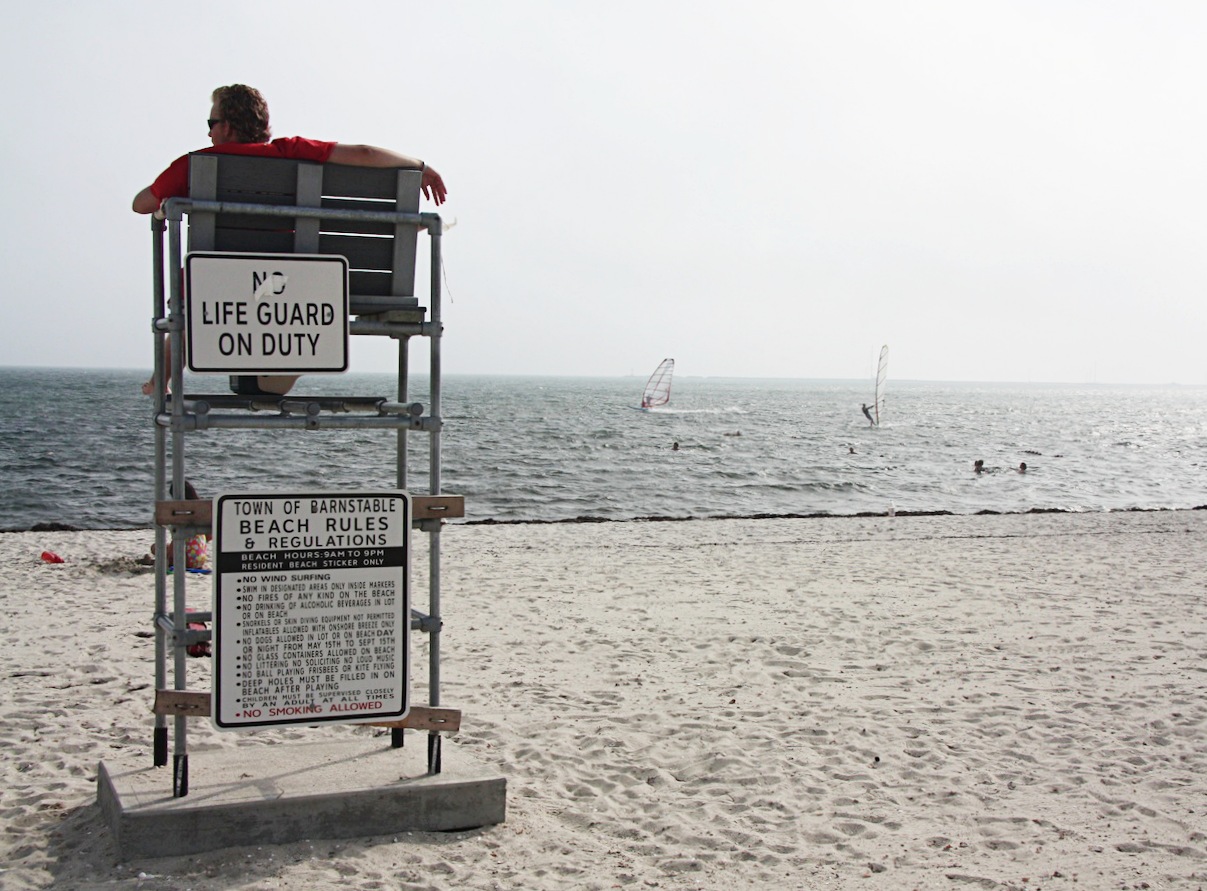
Kalmus Park Beach, at the southern end of Ocean Street 1.7 miles (2.7 km; 35- to 45-minute walk) from the Hyannis Transportation Center, and 6/10 mile (1 km) south of Veterans Park Beach, is actually two beaches: one toward the harbor and one toward the ocean. Surfing is allowed from the ocean beach. A bathhouse, toilets, lifeguard and snack sales serve both beaches, and there's pay parking.
Orrin Keyes Beach
At the southern end of Sea Street, 1.3 miles (2.09 km; 22- to 28-minute walk; map) from the JFK Museum, Keyes Beach (also called Sea Street Beach) has a bathhouse, toilets, lifeguard, snack stand and pay parking, and extends westward into the private Ocean Avenue Beach toward the Kennedy Compound.
Craigville Beach
Craigville is one of those l-o-n-g, sandy Nantucket Sound beaches that makes Cape Cod such a beach-lover's paradise. It extends along Centerville Harbor 4.3 miles (7 km) southwest of the Hyannis Transportation Center (map). Bath house with showers and toilets, snack stand and pay parking are the services.
Sandy Neck Beach
Sandy Neck Beach, off MA Route 6A facing Cape Cod Bay in West Barnstable, 10 miles (16 km) northwest of the Hyannis Transportation Center (map), is the town's finest northern, warm-water beach. It has the standard services: bath house with toilets, and snack stand.
Hathaway's Pond Beach
For freshwater swimming, Hathaway's Pond, on Phinney's Lane 3 miles northwest of the Hyannis Transportation Center, is Hyannis's contribution. There's a bath house with toilets.
Harbor Cruises
Among the most popular activities in Hyannis are the harbor cruises around the bay, with a stop to see the Kennedy Compound and perhaps the sunset. It's a classic Cape Cod activity: a daytime, sunset or moonlight cruise out of Hyannis Inner Harbor to survey the grand mansions and yachts along the shore, Great Island, Egg Island, Squaw Island, Point Gammon Light and other lighthouses, to smell the salt breeze and chat with other travelers.
Take your pick: a sleek, smooth, modern catamaran or a historic Maine coastal boat, but do get out on the water to see Hyannis from the water.
Reserve your place(s) in advance for either cruise, and be at the dock at least 30 minutes before cruise departure for boarding and safety instruction.
Bay Spirit Tours
Bay Spirit Tours operates guided Lighthouse Harbor tours and non-guided sunset cruises with its 63-foot (19-meter) motor catamaran Bay Spirit.
The Bay Spirit departs from Hyannis's Ocean Street Dock, adjoining Bismore Memorial Park, opposite the Black Cat Restaurant, and near the Hy-Line Cruises docks for ferries to Nantucket (map).
Hy-Line Cruises
Speaking of Hy-Line Cruises, they also operate one-hour Hyannis harbor cruises. In fact, it was this cruise that established the company back in 1962. More...
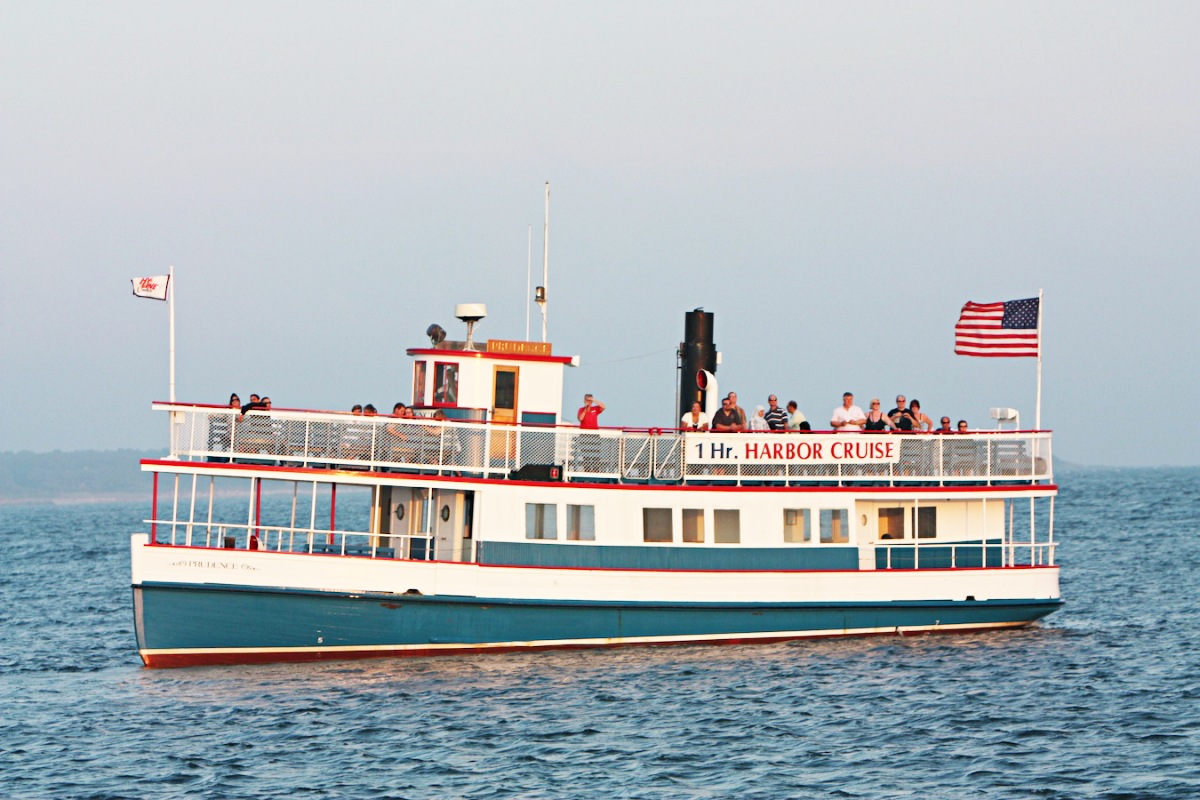
The Prudence with the wind astern.
Hy-Line also offers a Rail & Sail tour that includes a 2-hour scenic ride aboard the Cape Cod Central Railroad and a 1-hour harbor cruise. You pay less for the package than you would for the separate rail tour and harbor cruise, but you needn't take them together on the same day. It's a good deal.
Cape Cod Central Railroad
Take a train ride into the lovely countryside of Cape Cod and enjoy lunch, brunch or dinner in the dining car, freshly prepared right on the train.
I love trains! They're civilized. There's plenty of room and you can live normally as you travel: sit in comfort, stroll around and chat with other travelers, even enjoy fine dining as you roll.
New England has a number of scenic and historic railways.
The age of gracious train travel may be long past, but you can still experience it in Hyannis by boarding a Cape Cod Central Railroad excursion train for a 46-mile (74-km) ride through the beautiful salt marsh country and cranberry bogs of the Cape, all the way to the Cape Cod Canal and its bridges, enjoying fine dining as you roll.
Dine as you Travel
Your multi-course lunch, Sunday brunch or dinner is prepared fresh in the onboard kitchen and served by experienced railroad waiters right at your table decorated with fresh flowers. There's full bar service.
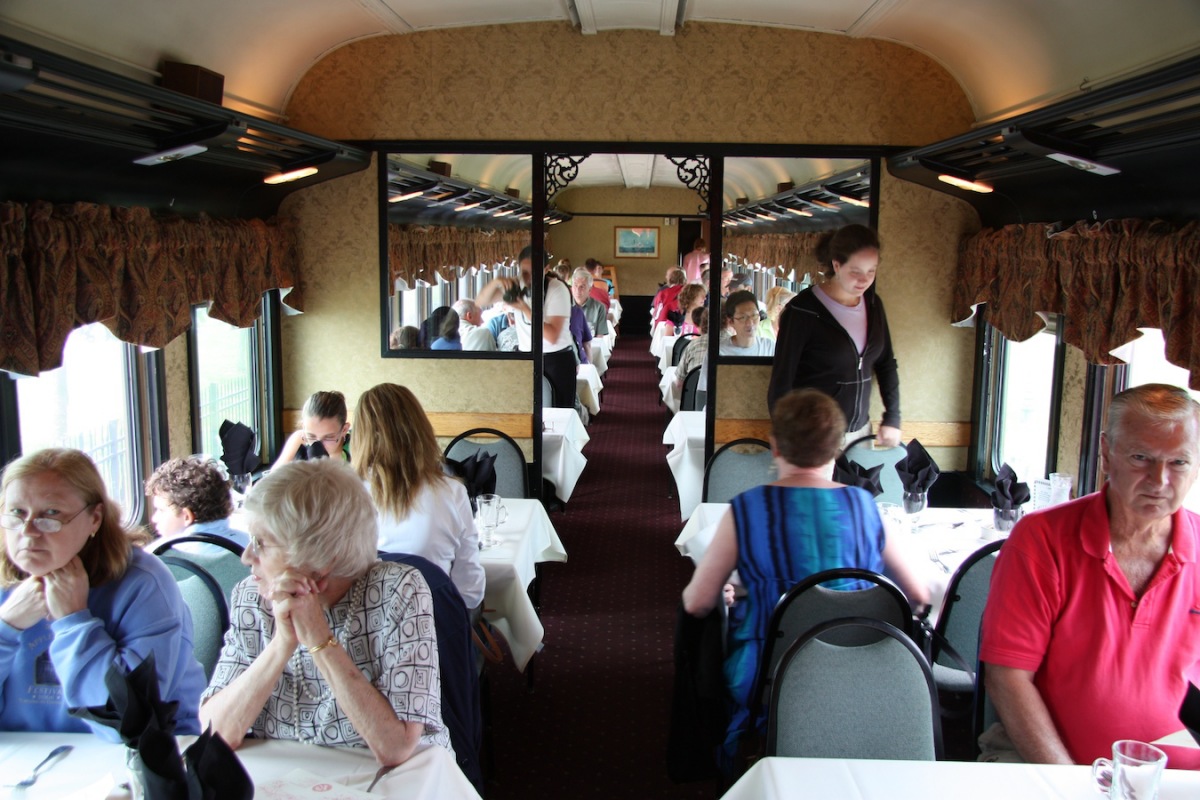
Nostalgic Comfort
You ride in authentic 20th-century rail cars that have been carefully restored and fitted with 21st-century safety and comforts, including climate control. Traction is by diesel locomotive.
Variety of Excursions
The Cape Cod Central Railroad offers a variety of rail excursions, including the Colonial Lunch Train, Yankee Clipper Brunch Train, Dome Car Dining, and special holiday trains, with First Class and Platinum Class options available.
The Train Station
The Hyannis railroad station is right in the town center at 252 Main Street (map), corner of Main and Center Streets (map), next to the Hyannis Transportation Center and within a few minutes' walk of downtown Hyannis.
You must have reservations to ride the trains, so call in advance.
Train + Harbor Cruise
By the way, if you'd like to take a Hyannis harbor cruise, Cape Cod Central Railroad has a package deal with Hy-Line Cruises: you get the 2-hour scenic train excursion and a harbor cruise at a discount. You needn't take both tours on the same day.
Kennedy Lore
The John F Kennedy Hyannis Museum, at 397 Main Street in the town center (map), is the most worthwhile "Kennedy site" in town. More...
Many visitors to Hyannis also stop to see the John F Kennedy Memorial, a stone monument bearing the presidential seal and a small fountain, on Ocean Street at Veterans Memorial Park (map).
You can also follow the Hyannis Kennedy Legacy Trail using your mobile phone as a guide. More...
Hyannis Port and the Kennedy compound, noted in news stories while the late President John F Kennedy and the late Senator Edward M Kennedy vacationed here, are west of Keyes (Sea Street) Beach and Ocean Avenue Beach. The Kennedy compound is not visible from the street and is not open to the public, so there's no point in going to look for it....by land.
But you can view the Kennedy Compound and much more on a Hyannis harbor cruise by day or at sunset.
Cape Cod Melody Tent
Big-name stars and bands are booked into the Cape Cod Melody Tent, at the West Main Street rotary (traffic circle) in Hyannis (tel 508-775-9100). The season goes from late June through early September, and runs the gamut.
Orleans MA
The Duke of Orleans made a visit to Cape Cod in 1797, and the townspeople named their town in the French nobleman's honor.
Orleans, 37 miles (60 km) east of the Cape Cod Canal and 26 miles (42 km) south of Provincetown (map), is where all Cape Cod roads meet.
US Route 6, the Mid-Cape Highway; MA Route 6A along the northern part of the Inner Cape; MA Route 28 along the southern part of the Inner Cape; and the Cape Cod Rail Trail bicycle path all meet in Orleans, from which US 6 continues north to Provincetown.
This central position makes Orleans a good place to stay if this is your first visit to Cape Cod, you only have a few days, and you want to tour most of the Cape.
Orleans doesn't have a lot of hotels, motels and inns, but the ones it has are quite nice, and value-priced.
Orleans's beaches are enjoyable (including those of the nearby Cape Cod National Seashore), the scenery is fine, and Orleans even has other interesting sights: a windmill and a historic communications museum, to name just two.
Besides its beaches, Orleans has a rare sight: a museum in the building erected to house the American terminus of a transatlantic telegraph cable from Brest, France to Cape Cod.
Beaches in Orleans
Several good beaches are a short distance from Orleans. Remember: the water at Atlantic-side beaches will invariably be cooler for swimming than the beaches on Cape Cod Bay.
Nauset Beach
This stretch of sand 10 miles long, is a town beach of Orleans and therefore is subject to a daily parking fee. The use of bathhouse and other facilities is included in the fee.
The surfing's not bad at Nauset, and a section of the beach is reserved for it.
Skaket Beach
This beach on Cape Cod Bay, has less surf, but warmer water and a gently sloping beach. It's operated by the town, with lifeguards, parking places, a bathhouse, and a daily use fee.
Pilgrim Lake
This freshwater swimming spot is operated by the town of Orleans. A sand beach runs into the clear water, and a lifeguard is on duty during the summer season. No charge for use of the facilities.
A short detour to the Fort Point off MA 6A reveals a breathtaking view of the surrounding salt marshlands. There are also some nice trails you can take down to the Nauset Marsh.
Other Orleans Sights
French Cable Station Museum
Laid in 1879, the cable came to Orleans in 1891, and the French Cable Station Museum, MA 28 and Cove Road, remains much as it was when the cable was still in use.
The cable later transmitted word of Lindbergh's arrival in Paris, and remained in use until 1959.
The museum is open in July and August, Tuesday to Saturday from 2 to 4 pm.
It's interesting to note that radio pioneer and Nobel prize winner Guglielmo Marconi went to nearby Wellfleet to set up the first wireless station to transmit signals across the Atlantic Ocean. Cape Cod was a good place from which to communicate to Europe.
Jonathan Young Windmill
Built in 1720, the historic windmill now situated in the center of Orleans, overlooking Town Cove just off the MA 28-MA 6A traffic circle (rotary), has moved around. It was taken to Hyannisport in 1897, but moved back to Orleans in 1983, restored, and erected on its present site.
Orleans History
Known as Nauset since its earliest settlement in 1644, the town was renamed Orleans in 1797 when it was separated from neighboring Eastham and incorporated.
In its day Orleans has made its living through fishing and shellfishing, clothing manufacture, agriculture, and the production of salt from seawater, not to mention trade in contraband.
During the Revolutionary War, Orleans sent men and supplies to aid the colonial forces.
In the War of 1812, the town refused to pay $1000 "protection money" demanded by the British enemy. A landing force was sent ashore from HMS Newcastle, and the town militia quickly convinced the Redcoats that it was probably a good idea to return to the ship, which they did. Needless to say, Orleans kept its $1000.
In 1879 Orleans was physically connected by underwater telegraph cable with the town of Brest in France, almost 4000 miles (6400 km) away. You can still see the telegraph station where the cable came ashore before continuing overland to New York.
When a German submarine broke the surface off Nauset Beach during World War I, the townspeople demonstrated their coolness in the face of danger, as they had during the War of 1812. The sub released a few torpedos at some coal barges, and everybody turned out to watch the show.
Where to Stay in Orleans
Being at the confluence of all major highways on Cape Cod, Orleans makes a good base for first-time visitors wanting to tour all of the Cape.
Orleans's selection of hotels, motels and inns is small, but of high quality.
For example, the 3-star, 47-room Cove Motel is aptly named, being located right at the edge of Orleans Cove, yet also only a minute's walk from the town center. Obviously, this is a popular place to stay—it fills quickly, so reserve your place early.
On the hill overlooking the confluence of the Cape's major roads is the 3-star, 51-room Governor Prence Inn, perhaps the most comfortable lodging in Orleans, with an outdoor swimming pool.
Use this Hotel Search Box to find the one for you:
Provincetown MA
In summer Provincetown, at the far northern tip of Cape Cod, is a carnival of people from New York, Boston, Montréal, Providence, Nowhere and Everywhere. P-town is 62 miles (100 km) NE of Sandwich, 50 miles (81 km) NE of Hyannis, a 2-1/2-hour drive from Boston... a 90-minute ferry voyage or a 30-minute flight.
Artists and writers, the successful and the hopeful, college sophomores and sophisticates, dowagers and down-at-heelers all mix along "P-town's" narrow streets.
Provincetown is separated from the rest of Cape Cod by sand, forest and marsh, and is virtually surrounded by the Cape Cod National Seashore (map), and thus has something of an island ambience.
The year-round inhabitants are mostly fishing families, descendants of hardy Portuguese sailors who came here for the whaling trade nearly two centuries ago.
A century ago, P-town was popular with artists as a summer resort. The local summer art colony grew to a tourist colony, and then grew larger.
Where to Stay in Provincetown
Advance Reservations!
Most important when planning a mid-summer visit to "P-town" (as the locals call it) in late July through August is to have a room reservation without fail.
It is simply not possible to find a room in Provincetown for the six weeks of hectic high season unless you reserve in advance. Weekends (Friday and Saturday nights) are the most crowded; "mid-week" nights (Monday, Tuesday, Wednesday, Thursday) are easier. Sunday night is in between. In June, early July and September, Provincetown lodgings are quite busy, but not as full as in high summer.
If you have no reservation for P-Town, you may plan to stay in Truro, Orleans or Wellfleet, or along US 6 some distance from P-town, and to drive to P-town for the day.
Hotel Map with Prices & Availability
Use this handy Hotel Map with Prices to find your desired lodgings in Provincetown.
LGBTQ+
A number of gay and lesbian visitors found P-town's tolerant atmosphere agreeable and brought their friends, and now there is a sizable LGBTQ+ scene here, especially in summer.
The great majority of establishments in Provincetown—hotels, inns, guesthouses, restaurants, cafes, bars, and nightclubs—welcome all customers regardless of gender orientation, including that of the owners. But in a few places, you may feel out of place if your preference doesn't match that of the proprietor and the majority of customers.
My own preference is for mutual respect and civility, tolerance in matters of personal choice, and absence of prejudice or discrimination in political, social, personal and commercial relations.
In summer nowadays, P-town is filled with tourists lodged in its many inns, motels and hotels, strolling along Commercial Street, window-shopping in the art galleries, sipping drinks and people-watching in the cafés and restaurants, climbing to the top of the Pilgrim Monument, setting out on whale-watch or schooner cruises, or riding bikes or riding in four-wheel-drive vehicles through the sand-dunes of the Cape Cod National Seashore.
It's all quaint or sophisticated, elegant or tawdry, depending on where you look and how you see it.
Getting There
MacMillan Wharf (or Town Wharf) in the center of Provincetown is where intercity buses begin and end their runs, and where the Provincetown Chamber of Commerce operates its information office.
Car
US Route 6, the Mid-Cape Highway, is a divided highway (mostly four lanes, but in some parts two lanes) all the way from the Cape Cod Canal to P-town (map), where it ends and brings you face to face with a parking problem.
Don't try to park in the center of P-Town unless you arrive early in the morning. Instead, get a space in one of the municipal parking lots (follow the signs) if you can find one.
Bus
Peter Pan Bus Lines
In summer, Peter Pan Bus Lines will take you from New York City (Port Authority Terminal, Greyhound counter) to Hyannis and Provincetown. The trip to P-Town takes 8 hours from New York City.
There are also buses from Providence RI (Peter Pan Terminal), a trip of 3.5 hours, and from Albany NY and Springfield MA to Hyannis, where you connect for P-town. In Hartford CT the Peter Pan terminal is at Union Station.
P&B Buses
Plymouth & Brockton Street Railway Company runs four buses daily in summer from Boston to Hyannis and Provincetown stopping at Harwich, Orleans, Eastham, Wellfleet and Truro.
Plane
Cape Air (tel. toll free 800-352-0714) flies between Boston's Logan International Airport and Provincetown several times daily in summer, a scenic trip of less than 30 minutes.
Ferry from Boston
You can take a delightful 3-hour cruise from Boston to Provincetown aboard the m/v Provincetown II, or a quicker 90-minute voyage aboard the fast catamaran ferry m/v Provincetown III, both operated by Bay State Cruises (tel 617-748-1428).
The ships' dock is at Boston's World Trade Center, a 12-minute walk from the South Station Transportation Center, or you can ride the MBTA Silver Line buses from South Station to the World Trade Center in about five minutes.
Breakfast, lunch, snacks, alcoholic beverages, and other refreshments are for sale, and both ships have open (sunny), covered (shady), and enclosed (air-conditioned) seating areas.
Ferry from Plymouth
From late June through September, Captain John Whale Watching & Fishing Tours operates a fast ferry from the Town Wharf in Plymouth to MacMillan Wharf in Provincetown. The voyage takes about 90 minutes.
Local Transit
The Cape Cod Regional Transit Authority (CCRTA) connects Provincetown with other Cape Cod towns and villages by bus, and The Shuttle in Provincetown connects the main points in this long, spread-out town, from Race Point Beach in the north through the P-Town Airport, Herring Cove Beach, MacMillan Pier, the P&B Bus Stop, and North Truro.
Beaches
The tip of Cape Cod is all sand, so any shore is usually a beach. Provincetown's best are part of the Cape Cod National Seashore.
Beaches in Town
As Provincetown—and indeed the entire tip of Cape Cod—is all sand, just about every shore not covered by a building is beach. If it's on the shore, you may have direct access from your hotel or inn to the sea.
But for long sunning and swimming sessions, you'll probably want to make the short trek to one or another of Cape Cod's finest beaches:
Herring Cove Beach
If you follow US Route 6 to its northwestern end at Herring Cove at the far western end of Provincetown, 2miles (3 km) west of MacMillan Pier, you'll be at Herring Cove Beach, the warmer of the tip-of-the-Cape's two organized beaches, both of which are parts of the Cape Cod National Seashore.
The sea water is calm at Herring Cove, there's no dangerous undertow to speak of, and you may even spot whales breaching in the offing, or seals splashing and playing.
Showers, toilets, lifeguards, and food stands are yours for a relatively low parking fee, which you don't pay if you walk or bike to the beach.
Come in the evening for the sunset over Cape Cod Bay, an unusual vista on the US East Coast, where most sunsets (except on Florida's west coast, overlooking the Gulf of Mexico) take place over land. No parking fee to pay in the evening.
Race Point Beach
If Herring Cove is where you go for calm water, Race Point Beach, 3 miles (5 km) northwest of MacMillan Pier, on the very northern tip of Cape Cod, is where you go for Atlantic surf. The lighthouse here is a good goal for a walk. There are lifeguards on the beach.
In summer, shuttle boats will take you from MacMillan Pier and from Flyer’s Boatyard in Provincetown's West End to Race Point Beach.
Head of the Meadow Beach
Head of the Meadow Beach, at the end of Holden Street, 7.3 miles (12 km) east of MacMillan Pier in the Cape Cod National Seashore, is actually in the neighboring town of Truro, but easy of access if you have a car, or by bike trail if you have a bike. The National Park Service provides lifeguards and toilets.
Pilgrim Monument & Provincetown Museum
The granite Italian-style Pilgrim Monument tower on the hill at 1 High Pole Hill Road (map) offers panoramic views of the town and the tip of Cape Cod, but at a price: you must c-l-i-m-b the 252.5 feet (77 meters) to the top. The Provincetown Museum, at the base of the tower, is easily accessible though.
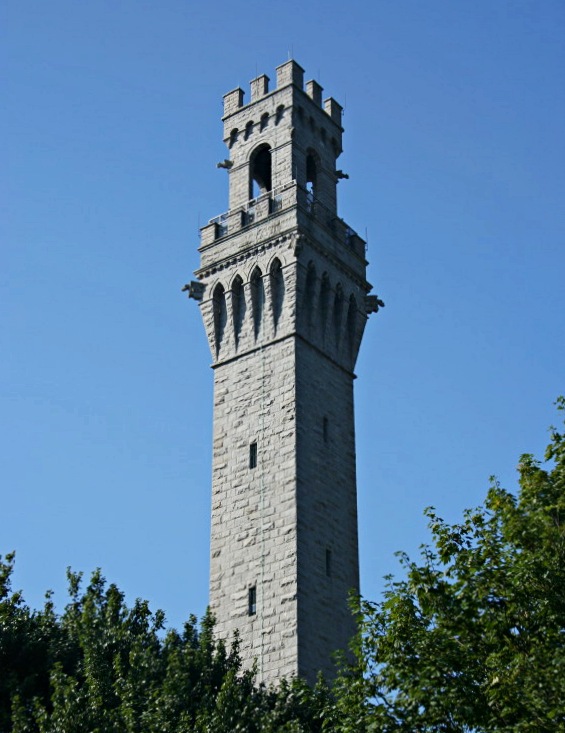
Modeled on the Torre del Mangia in Siena, Italy, the granite tower on a hill in the center of Provincetown (map) is 252.5 feet (77 meters) high. The cornerstone was laid in 1907 with President Teddy Roosevelt in attendance, and the structure was completed three years later, when President Taft did the dedicating.
How do visitors get to the top to enjoy the view? Well, there's no elevator, so you c-l-i-m-b the 116 steps and 60 ramps, the equivalent of climbing to the top of a 20-story building. (The Monument's website cheerily terms it a "heart-healthy walk" that takes only about 10 minutes at a leisurely pace.)
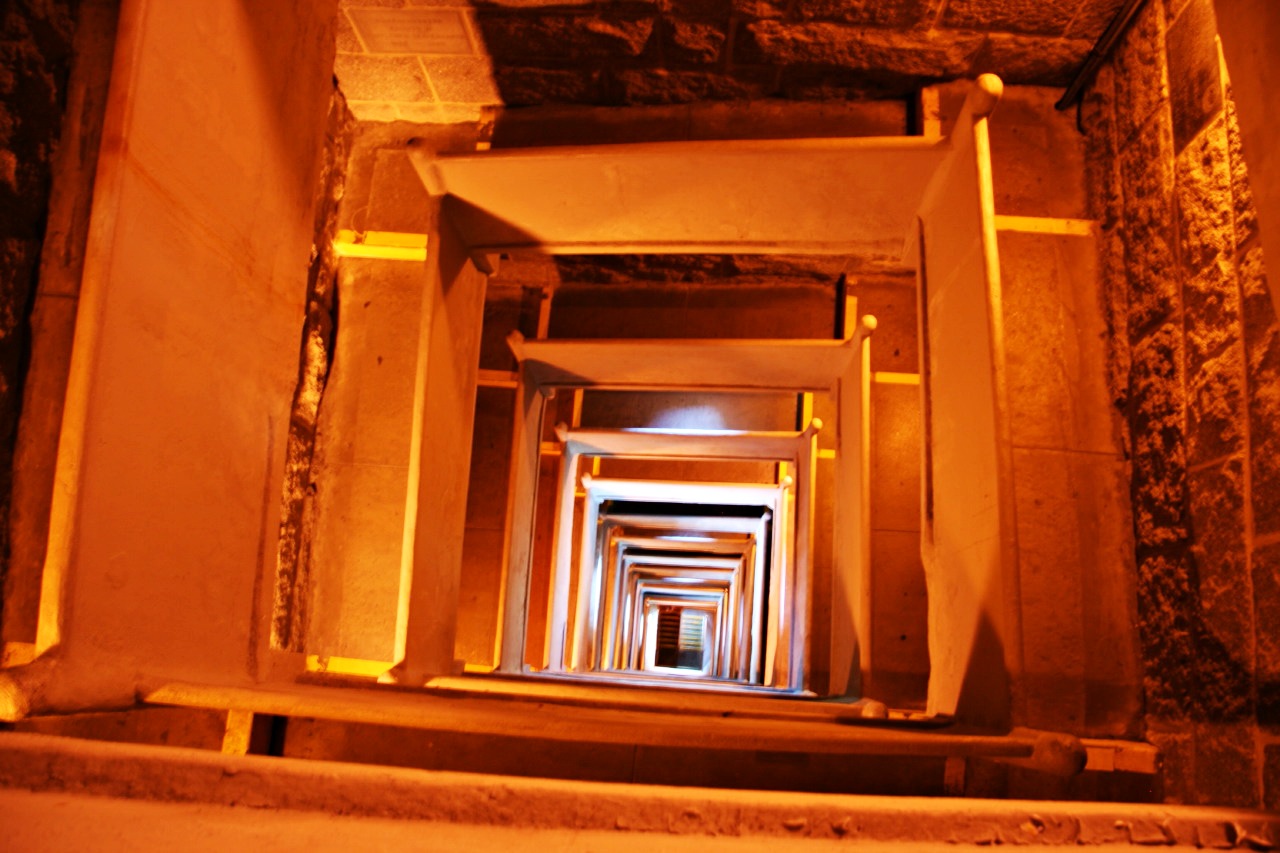
View down the stairwell of the Pilgrim Monument.
Most of the climb is on a ramp, not steps, and you can take your time and read the commemorative plaques from New England cities, towns, and civic groups which line the granite walls. The view is worth the climb: Provincetown and all Cape Cod spread out like the maps you've been following.
The Provincetown Museum is an interesting potpourri of old firefighting gear, costumes, a whaling ship captain's quarters on board, primitive portraits, World War I mementos, arctic lore, and a sequence of displays on the activities of the Pilgrims in Provincetown, for this is the first place they touched land in the New World.
After seeing these you can continue with the Wedgwood, model of a Thai temple, antique dolls, and other arcana.
Provincetown Beaches
P-Town is all sand, everything's a beach, but these beaches are where you go for a really good day of sun, sand and sea.
A Walk Around P-Town
Drop in at the Chamber of Commerce's information office down by MacMillan Wharf and pick up the Provincetown Historical Society's pamphlet guide to the historic sights and houses in P-town.
Check out the Pilgrims' first landing place, the monument commemorating the signing of the Mayflower Compact (America's first democratic "constitution"), and the 12-room Seth Nickerson House, the oldest dwelling in town (1746), at 72 Commercial Street.
Provincetown Art Association & Museum
Provincetown has been a thriving artists' colony since the 1800s. The Provincetown Art Association and Museum (PAAM), founded in 1914, is a professional association of 700 contemporary artists. Its collection of more than 3000 artworks by 700+ artists, was gathered over a century.
Provincetown Artists
Should you want to do nothing more active than sit, you can have a local artist do your portrait in pastels while you're sitting. Artists' shops are along Commercial Street and inside Whalers' Wharf near MacMillan Wharf. Your portrait can be done, framed, and wrapped to take home in a surprisingly short time.
Provincetown Heritage Museum
The municipal museum at Commercial and Center streets (tel 508-487-0666), preserves the town's heritage in its wide-ranging displays. Relics of the fishing industry, Victoriana, and many other items capture Provincetown's history.
Kids like the antique fire engine and the Rose Dorothea, the world's largest half-scale fishing schooner model.
Art Galleries, Cinemas & Theater
The latest schedules for galleries, cinemas, and theater are published in the local newspaper, the Provincetown Advocate.
Art galleries dot the downtown streets, often open until late in the evening.
The Provincetown Playhouse on the Wharf (tel 508-487-0955), 501 Commercial St, is active all summer.
The New Art Cinema (tel 508-487-9222), across from the post office at 212 Commercial Street, plays both foreign and domestic first-run films.
Bicycle Rentals
Arnold's Rent-a-Bike, at 329 Commercial Street (tel 508-487-0855) gets you on wheels to tour P-town or the bike trails in the Cape Cod National Seashore.
Drop in at the Seashore's Province Lands Visitor Center for a free guide pamphlet to the trails.
Whale-Watch Cruises
Believe me, it's a thrill to see a monster denizen break the surface, spout, sport and play. You can sight whales from the Coast Guard Station on Race Point Beach, and even with the naked eye you can see them spouting and rolling. But to see them up close is something else, and for that you need to sign up for a whale-watch cruise.
You can sight whales from the Coast Guard Station on Race Point Beach, and even with the naked eye you can see them spouting and rolling.
But to see them up close is something else, and for that you need to sign up for a whale-watch cruise.
The whales—which seem to perform expressly for the appreciative crowds on the boats—seem to enjoy the trip as much as you do.
Several boats leave on morning and afternoon runs, and give you several hours in which to find and watch the whales. Boats leave from MacMillan Wharf.
Contact these whale-watch cruise companies:
Dolphin Fleet (tel 508-255-3857 or toll free 800-826-9300), which by the way has a 99.7% sighting record
Portuguese Princess Excursions (tel 508-487-2651 or toll free 800-442-3188)
Whale's Tales Tours (tel 508-497-2980 or toll free 800-942-5376); or the Ranger V (tel 508487-1582 or 487-3322, or toll free 800-992-9333) for times, prices, and reservations.
Schooner Cruises
What about a sail on a schooner? Several sleek sailing ships make 2-hour cruises through the waters around the tip of the Cape, giving you a different view of land and water.
Those who want more action on their cruise can go out with one of the two daily deep-sea fishing voyages that leave from MacMillan Wharf.
Boat Rentals
Biking, schooner sails, deep-sea fishing, and portrait-sitting can't equal the sense of freedom you get if you sail your own boat in Cape Cod Bay. Flyer's Boat Rental, 131A Commercial Street (tel 508-487-0898) will rent you a little Sunfish, larger (18- to 20-foot) sailboats, dinghies with outboard motors, or dinghies with just a pair of oars. Flyer's will even teach you how to sail.
Sandwich MA
Much of the vacation traffic to Cape Cod rushes past Sandwich (map) on the way to Hyannis or Provincetown, leaving the town to those who appreciate its quiet grace, beauty, history and charm.
Settled in 1637 and incorporated as a town in 1639, Sandwich MA calls itself "the oldest town on the Cape," and it is certainly historic.
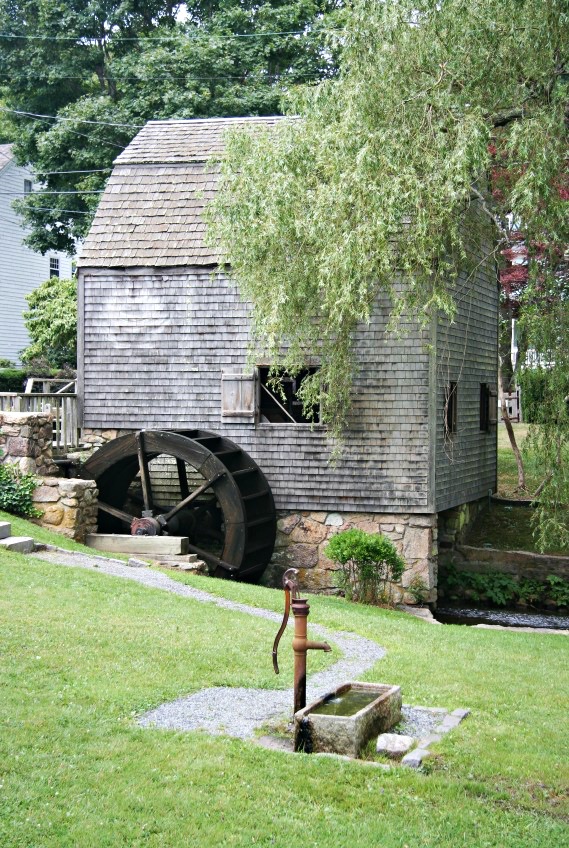
Dexter's Grist Mill (1654), in the center of Sandwich MA on Cape Cod.
Sandwich holds its appeal both winter and summer, for although it has beaches, its antique stores and gracious old houses, some of which are now museums, also draw visitors. Visitors come here less for beaches than for old New England charm.
Among its lodging places are several historic inns, and some convenient modern hotels.
Other attractions are Dexter's Grist Mill, the Sandwich Glass Museum, Heritage Museums & Gardens.
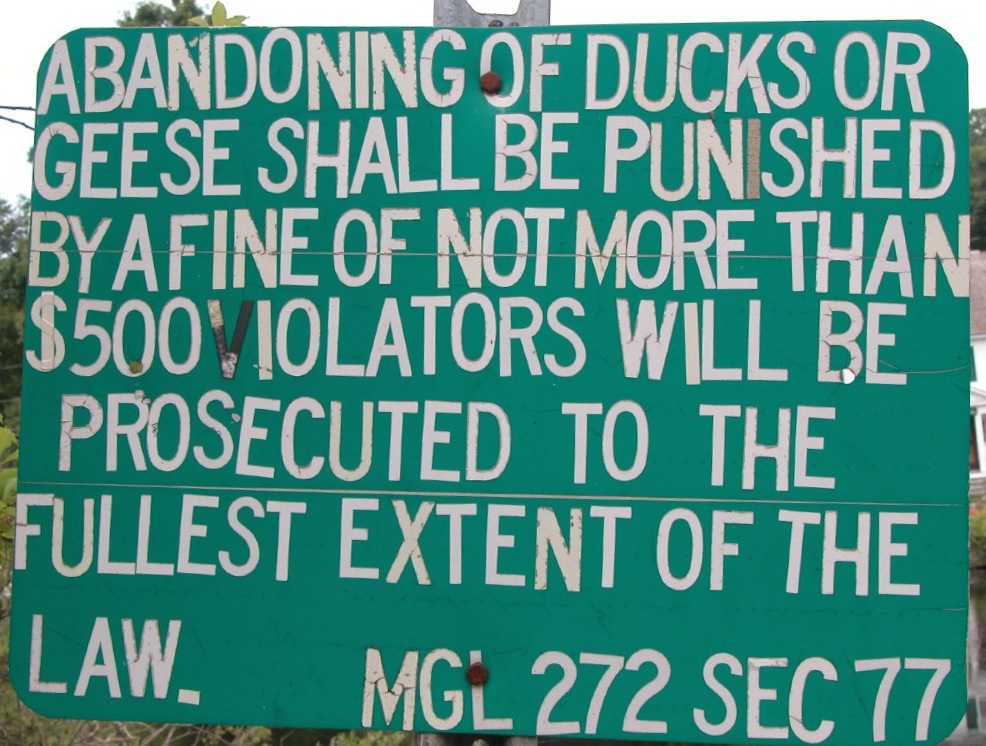
Just don't abandon any ducks or geese there....
Beaches
The many beaches in Sandwich MA face Cape Cod Bay, where the water is warmer than on the south (Nantucket Sound) side of the Cape.
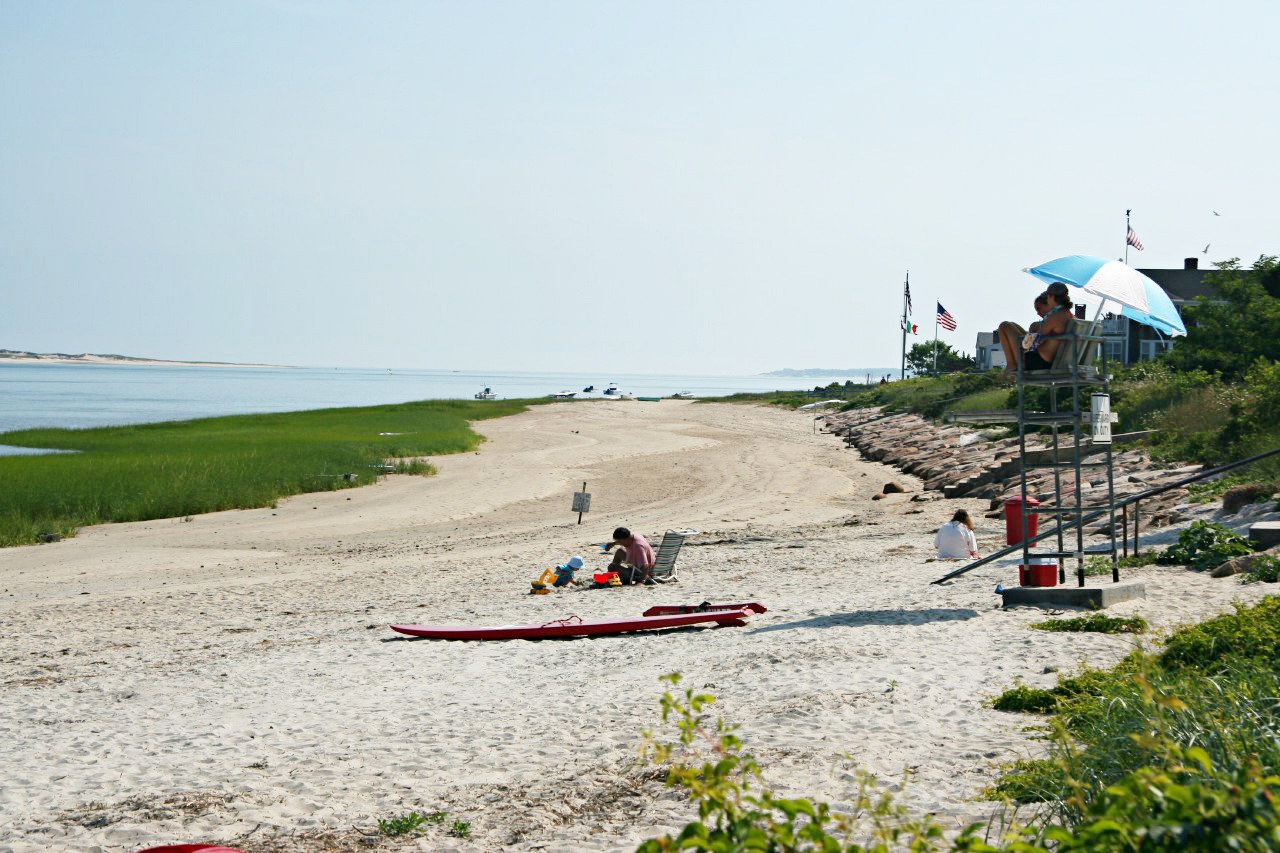
Sandy Neck Beach, entered from Sandwich but actually in Barnstable.
The beaches of Sandwich, on Cape Cod, include Town Beach, the most westerly, and then, in order heading east along the shores of Cape Cod Bay, Spring Hill Beach, East Sandwich Beach, and over the line to the east in Barnstable, Sandy Neck Beach (map).
A day-use fee is payable at most beaches in summer.
Look for signs to the beaches on the side roads left (north) off MA 6A between Sandwich and Barnstable.
All these beaches have toilets and places to park, most have lifeguards, and the Cape Cod Bay side of Cape Cod has generally warmer swimming than the Atlantic Ocean side.
Dexter Grist Mill
An old mill (1654) at the end of a lovely mill pond right in the center of Sandwich, it's still in operation, it's ancient wooden mechanism grinding corn into cornmeal—which you can buy. This early American mill in the center of Sandwich is at the end of a lovely mill pond (Shawme Pond) complete with ducks, and next to a cool, splashing mill race and an old pump.
Dexter Grist Mill, at the intersection of Main and Water streets in Sandwich (map), was built in 1654, fully restored in 1961, and got a new, larger waterwheel in 2015.
The mill is not just a picturesque landscape attraction. It's still a working mill! You can go in and see the wooden mill mechanism at work grinding corn (maize), and you can buy bags of fresh cornmeal the same day it's ground.
Thomas Dexter built the first grist mill on this site in 1654 so that the inhabitants of the village of Sandwich would not have to grind their own corn for cornmeal, their staple food.
Today you can buy cornmeal ground in the mill, along with recipes for dishes similar to those the early inhabitants of Sandwich might have made daily.
The mill is open from mid-May through early September, daily from 10 am to 5 pm. An admission fee is charged to enter the mill.
From the mill, the famous Sandwich Glass Museum is right across the street.
Just a few minutes' walk from the mill along Water Street takes you to the Thornton W Burgess Museum, and Hoxie House, another historic landmark from the 1600s.
Sandwich Glass Museum
Sandwich was a major glass-producing town from 1825 to 1888, and the Sandwich Glass Museum, 129 Main Street, can show you all about this prized American-made molded glass.Across from the Greek Revival town hall of Sandwich MA on Cape Cod is the Sandwich Glass Museum, 129 Main Street (map).
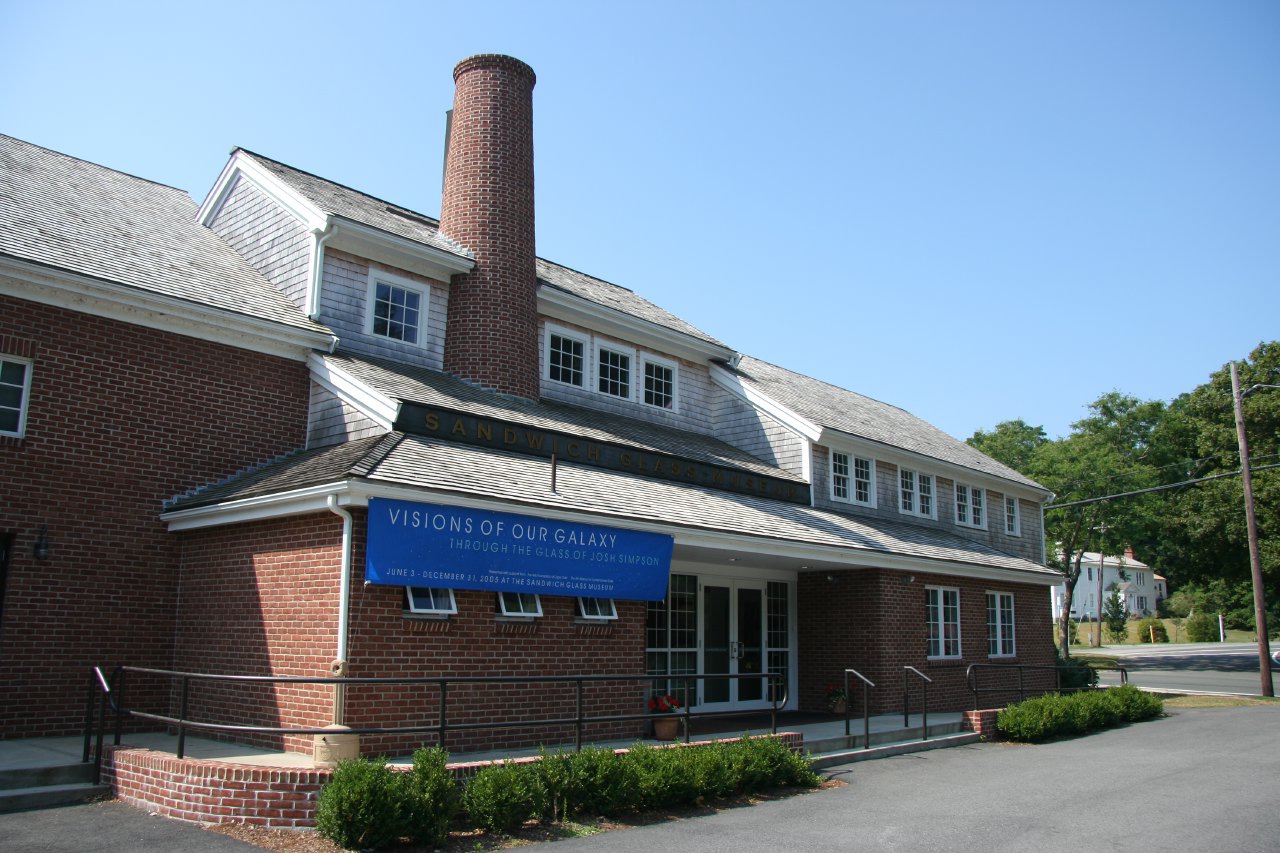
Sandwich Glass Museum, complete with historic glassworks chimney.
Sandwich was a major glass-producing town from 1825 to 1888, and although it specialized in the new process of pressing glass in a mold, it produced blown, cut, etched, and enameled works as well.
A brilliant collection of this American glassware is on display, and dioramas, videos, and pictures show how it was made.
Glassmakers' tools and other articles of Sandwich memorabilia are also part of the museum's collection.
It's open daily from April through October, closed Monday and Tuesday from November through March, but closed for all of January.
For opening times and admission fees, see the Sandwich Glass Museum website.
Hoxie House
Among the oldest houses in the USA, Hoxie House dates from the late 1600s, and is furnished with objects from that time. It's just a five-minute walk from Dexter's Grist Mill along Water Street (MA 130).
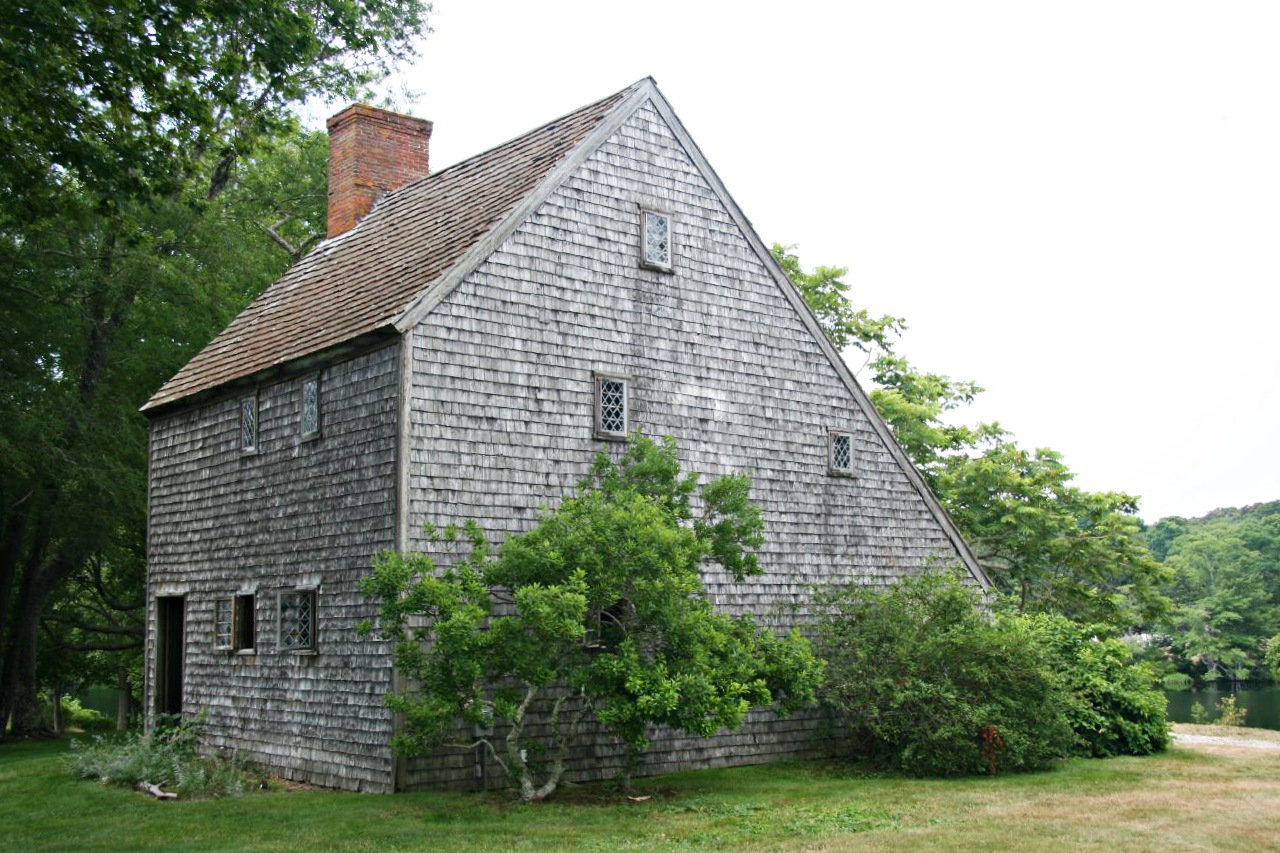
Hoxie House, next to Shawme Pond in Sandwich
Hoxie House is open from mid-June to September, Monday through Saturday 10 am to 5 pm, Sunday 1 to 5 pm.
A combination ticket good for Hoxie House and Dexter's Grist Mill offers the best value if you'd like to see these two Sandwich landmarks from the 1600s.
Heritage Museums & Gardens
Exhibits from all periods of American history: automobiles from 1899 to 1936, firearms and military miniatures, American crafts and tools, as well as reproductions of early American buildings, including a superb Shaker round barn.
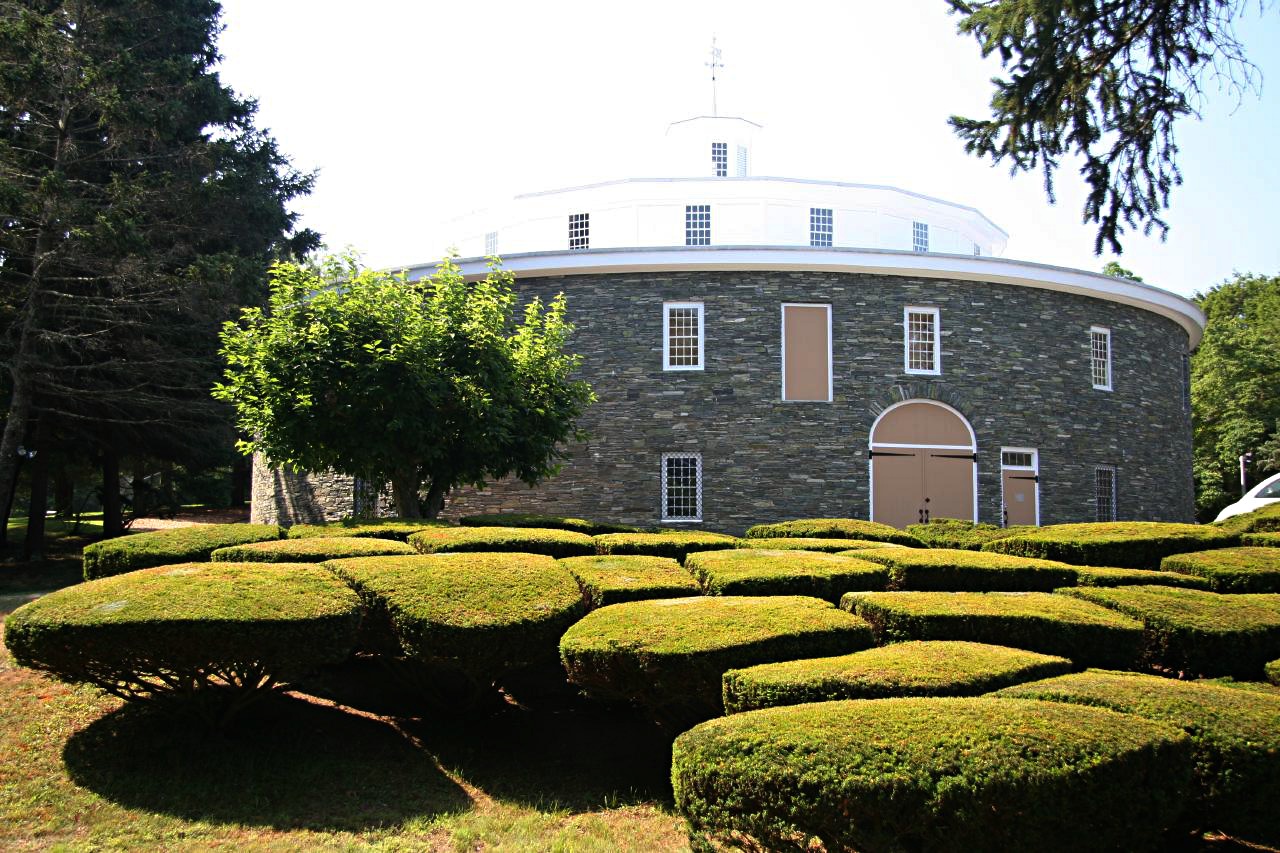
Perhaps the most famous local attraction in Sandwich MA is Heritage Museums & Gardens, 67 Grove Street, a mile from Dexter's Grist Mill on Grove Street.
Heritage does not specialize in any one era but has exhibits from all periods of American history. The automobile collection, 34 cars dating from 1899 to 1936, is one of the most popular sights in town.
Another collection features firearms and military miniatures, and still others show American crafts and the tools used to perform them.
The buildings and grounds of the plantation are an attraction in themselves: all are reproductions of early American buildings (including a superb Shaker-style stone round barn) set in gardens and nature areas covering 76 acres (31 hectares).
It's open mid-May to mid-October daily, 10 am to 5 pm.
Where to Stay in Sandwich
Sandwich, the first town you encounter on Cape Cod after crossing the Sagamore Bridge over the Cape Cod Canal, is a fine place to stop for the night.
Perhaps the most prominent Sandwich hotel is the 4-star, 48-room Dan'l Webster Inn & Spa, with a full-service spa, five dining rooms, an outdoor swimming pool, and hot tub. Some rooms have fireplaces and spa tubs.
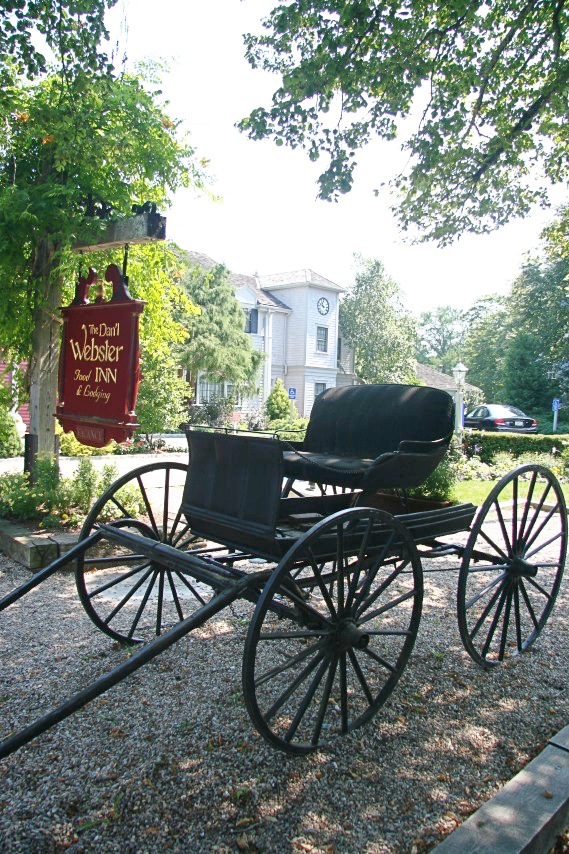
Dan'l Webster Inn & Spa.
The atmospheric 3-star, 23-room Belfry Inne & Bistro is within walking distance of the Sandwich Glass Museum. Its bistro serves lunch, dinner and Sunday brunch.
The nearby 3-star, 7-room Isaiah Jones Homestead Bed and Breakfast is historic, cozy and convenient. The 3-star, 5-room 1750 Inn at Sandwich Center is even cozier, with flowered patio and garden for good weather, an indoor hot tub for when it rains.
The 2-star, 75-room Sandwich Lodge & Resort, on MA Route 6A west of the town center, is modern and convenient with microwave oven and mini-fridge in the guest rooms, indoor and outdoor swimming pools, a barbecue grill, and budget rates.
Use this handy Hotel Search Box to find room rates and availability for hotels and inns in Sandwich and nearby towns:
Truro MA
Just southeast of bustling Provincetown, Truro is a sleepy town surrounded by the Cape Cod National Seashore. Local people like it that way.
What a contrast! In summer Provincetown, at the tip of Cape Cod, is bustling with locals, summer residents and day-trippers, its shops busy, its restaurants and cafes crowded, its streets a constant flow of traffic.
Meanwhile, in neighboring Truro, the town's minuscule commercial district is a scene of lazy summer calm because everyone's at the beach or taking a nap or reading a book in the hammock.
Rental cottages far outnumber hotels, motels and inns in Truro, so most visitors come to stay for a week or more. If they want activity and nightlife, they make the short trip to P-Town.
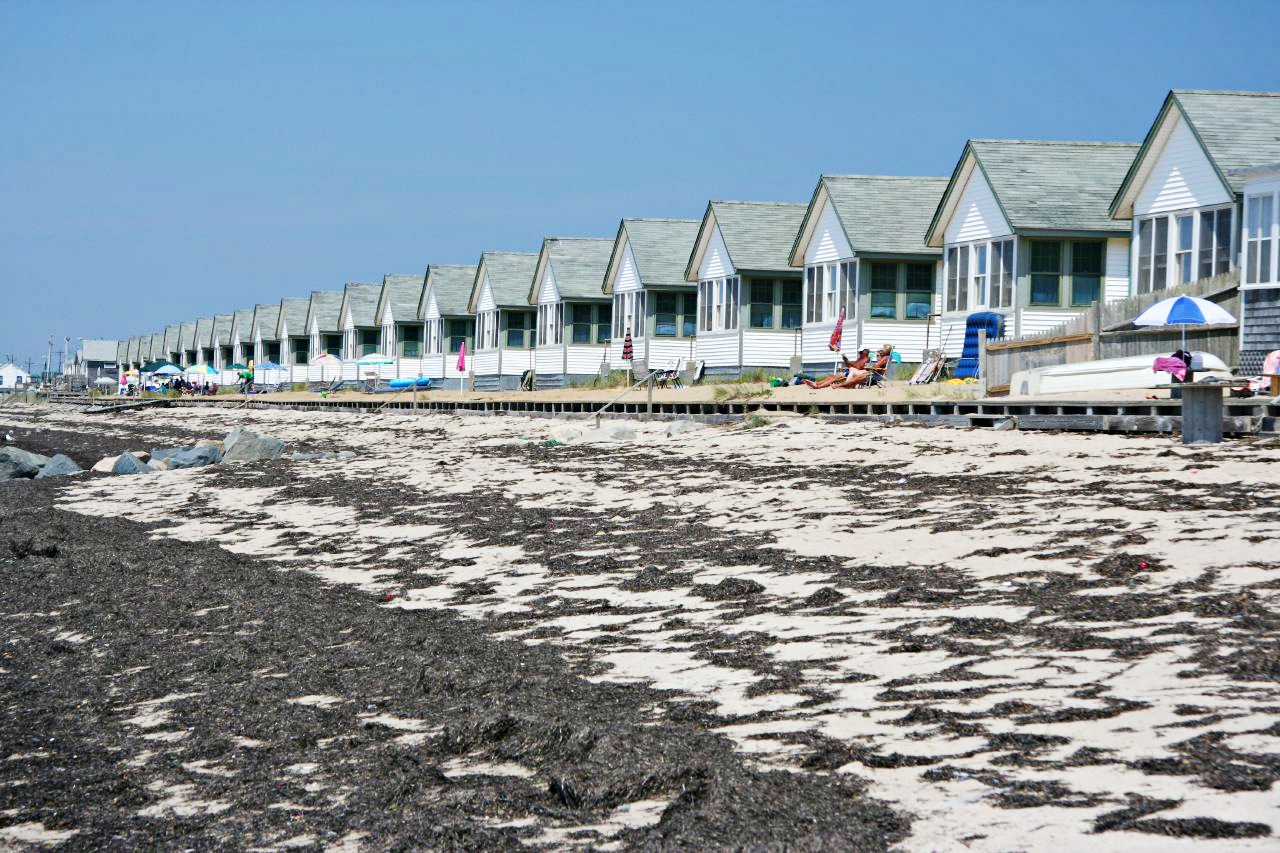
Days' Cottages, for rent on the beach in Truro MA on Cape Cod.
Several Truro attractions are worth a stop, however.
Truro Center for the Arts at Castle Hill
The local arts center hosts concerts, exhibits, forums, lectures and shows to bring together artists, artisans and the community at large, both children and adults. More...
Truro Vineyards of Cape Cod
If you're just passing through, stop for a tour, a tasting, and/ or the purchase of a few bottles of wine at Truro Vineyards of Cape Cod, a winery on the west side of MA Route 6A, easily accessible as you head south from Provincetown toward Wellfleet.
Wellfleet MA
Cooking lobsters and corn on the cob at a beach picnic, meeting friends downtown at the lunch counter for a midmorning's lazy second cup of coffee, running errands barefoot or in rubber thongs...
If you've enjoyed that sort of an easy summer atmosphere, Wellfleet will bring it back to you.
Although a number of motels on US 6 (map) take in travelers heading for Provincetown, and a few small inns put up travelers on Wellfleet's quiet streets, Wellfleet is mostly a town of "steadies," people who come every summer for all summer.
But it is surrounded by the Cape Cod National Seashore, it does have good wildlife viewing, a few restaurants worth a look should happen to be here at mealtime, and one of the last operating drive-in cinemas in the USA.
Before heading out to see the birds and the salt marshes, stroll along Wellfleet's pretty Main Street for a look in the shops.
Note the town clock in the steeple of the First Congregational Church, which, Wellfleetans proudly say, is the only church clock in the world that rings ship's time.
Out of the center, on US 6, is the Wellfleet Drive-In Theatre, one of the last operating drive-in movie theaters in the USA. Of course, there are now indoor cinemas here as well, and the drive-in's parking area is used for flea markets during daylight. But if you're driving a convertible car (or any car for that matter) and want to live some 1950s American nostalgia, this is the place.
Wellfleet's beaches are mostly reserved for permanent or all-summer residents (you need two different permits to swim there, and if you're passing through it's not worth getting them), but White Crest Beach and Cahoon's Hollow Beach, off US 6 on the Atlantic coast, are open to day visitors for a fee.
You can always go south on US 6 a short distance from Wellfleet and turn left (east) to the Marconi Beach in the Cape Cod National Seashore.
At Marconi Beach is an ocean overlook and an interpretive shelter explaining the activities of the Marconi Wireless Station, the first in the United States, which was on this site.
The Atlantic White Cedar Swamp nature trail starts from here as well.
The Massachusetts Audubon Society operates the Wellfleet Bay Wildlife Sanctuary (tel 508-349-2615), 700 acres of woods and marshland which you can see on your own or by guided tour. The sanctuary is open all year long and interpretive walks are given year round. There are also birding tours to Monomoy National Wildlife Refuge.
Woods Hole MA
Marine science is the lifeblood of Woods Hole MA, near Falmouth on Cape Cod, but it's the car ferry to Martha's Vineyard that causes the traffic jams.
Scientific laboratories and offices take up most of the space at the tip of the tiny peninsula on which Woods Hole is built (map), leaving room for only a few streets of old houses, a few small boatyards, a restaurant or two, and the large docks and parking lots for the Woods Hole, Martha's Vineyard & Nantucket Steamship Authority's car ferry to Martha's Vineyard.
The Marine Biological Laboratory at Woods Hole is one of the world's great centers for the study of sea life. Besides the laboratory, Woods Hole is home to the Woods Hole Oceanographic Institute (WHOI), the Northeast Fisheries Center of the National Marine Fisheries Service, and the US Geological Survey's Branch of Atlantic Geology.
WHOI's Ocean Science Exhibit Center at 15 School Street has displays explaining the work of WHOI, its scientists and engineers, and showing some of the instruments used in their research.
In summer, WHOI personnel lead visitors on walking tours through the Institute's dock and other restricted areas to give you a feel for the Institute's work.
The US Department of Commerce's National Marine Fisheries Service maintains the Woods Hole Science Aquarium on Water Street (the town's main street) down at the end of the peninsula.
Follow Water Street through the town; just after it turns right, the aquarium is on your left. It's open mid-June to mid-September from 10 am to 4 pm daily; from 9 am to 4 pm the rest of the year; admission is free.
Transportation
Woods Hole, 6 miles (10 km) southwest of Falmouth MA, is 45 minutes by car ferry from Vineyard Haven, on the island of Martha's Vineyard.
Ferry to Martha's Vineyard
The Steamship Authority operates car ferries from Woods Hole to Vineyard Haven and Oak Bluffs on Martha's Vineyard, and from Hyannis to Oak Bluffs (Martha's Vineyard). (There are no ferries to Edgartown.)
Separate car ferries and passenger-only ferries sail from Hyannis to the island of Nantucket, and between the islands of Martha's Vineyard and Nantucket.
The car ferries also carry passengers without cars, and passengers with bicycles.
You should have a reservation to ship your car off-season (November through May), and you must have a car reservation in the high-summer months from mid-June through early September.
Parking
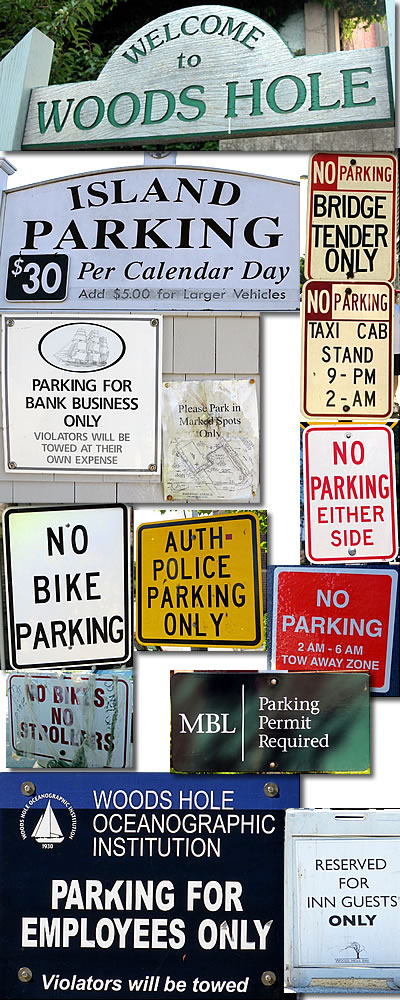
If you plan to take the ferry, do not park in Woods Hole. Follow signs to the Steamship Authority parking lots in Falmouth. If you ignore this advice and try to park in Woods Hole, you will probably be fined and your car towed.
If you plan to visit Martha's Vineyard island for only a day or two, it's probably best to leave your car in a parking lot in Falmouth, ride the ferry as a passenger, and use public transportation on the island.
In summer, it is impossible to find a free, legal parking place for a full day or for overnight. You must park your car in a Steamship Authority parking lot, or a small private parking lot. (The Steamship Authority's lots are easier, though perhaps a bit more expensive than the few small private lots.)
The Steamship Authority has numerous parking lots in Falmouth, connected to the Woods Hole car ferry dock by free shuttle buses. Use them!
For the latest ferry and parking information, look at the Steamship Authority Mobile website or full website; or, as you drive to Falmouth and Woods Hole, tune your car radio to the AM radio station indicated on the signs you'll see as you approach Falmouth.
Welcome to Woods Hole...
Buses to/from Woods Hole
In high summer, Peter Pan runs buses between the Steamship Authority car ferry docks in Woods Hole and Boston, Providence RI and New York City.
Although bus schedules leaving Woods Hole are designed to work in conjunction with ferry arrivals, connections are not guaranteed because bad weather can make the ferry late, and the bus does not wait for a late ferry. It departs according to its published schedule.
Avoid taking the last ferry of the day from Martha's Vineyard to Woods Hole (or to Hyannis). It may not arrive in time for the departure of the last bus of the day. You may in fact arrive in time, but it's not dependable—the bus departs at its scheduled time, not upon arrival of the ferry.
Take an earlier ferry, or be prepared perhaps to spend the night in Woods Hole or Falmouth.
Where to Stay in Woods Hole
Staying overnight in Woods Hole is not particularly cheap, although it can be pleasant.
Several quite comfortable motels dot the hills just up from the ferry docks, and there are plenty more accommodations in neighboring Falmouth MA.
In fact, you might decide to stay in Falmouth or Woods Hole and take the ferry to Martha's Vineyard on a day-trip rather than overnight, as hotels on Martha's Vineyard tend to be more expensive than landward lodgings.
Yarmouth MA
Yarmouth is a Cape Cod town three villages, each with its own character, some fine historic houses, natural beauty, and lots of beaches.
Along the town's southern shore facing Nantucket Sound, in the districts known as West Yarmouth and South Yarmouth, are most of Yarmouth's splendid salt-water beaches backed by a variety of beachfront hotels, motels and inns.
In the north along MA Route 6A (map) toward Cape Cod Bay, Yarmouth Port is a village of dignified old houses, a New England country store, and several beautiful inns, all shaded by lofty trees.
In between, along MA Route 28 in the villages of West Yarmouth and South Yarmouth, are hotels and motels in a long commercial strip—the largest concentration of motel rooms on Cape Cod.
The rest of Yarmouth is forested and dotted with freshwater ponds, some of which have good recreation areas with freshwater beaches.
Yarmouth, being central on Cape Cod, and having lots of lodging choices in all price ranges, makes an excellent base for your time on Cape Cod.
Despite its modern attractions and facilities, Yarmouth is not a new town. When European settlers arrived here in the 1630s, it was already home to the Hokanum, Pawkunnawkut and Cummaquid peoples, who called it Mattacheese.
Originally part of Plymouth Colony, Yarmouth was incorporated as a town in its own right in 1793, and named after Great Yarmouth in Norfolk County, England.
Yarmouth Beaches
Yarmouth has lots of beaches—on Nantucket Sound, on Cape Cod Bay, salt-water, fresh-water—and some of them are among Cape Cod's best.Most of Yarmouth's salt-water beaches are along the southern shore on Nantucket Sound in West Yarmouth and South Yarmouth, but there's one—Bass Hole (Grey's) Beach—on the north shore facing Cape Cod Bay.
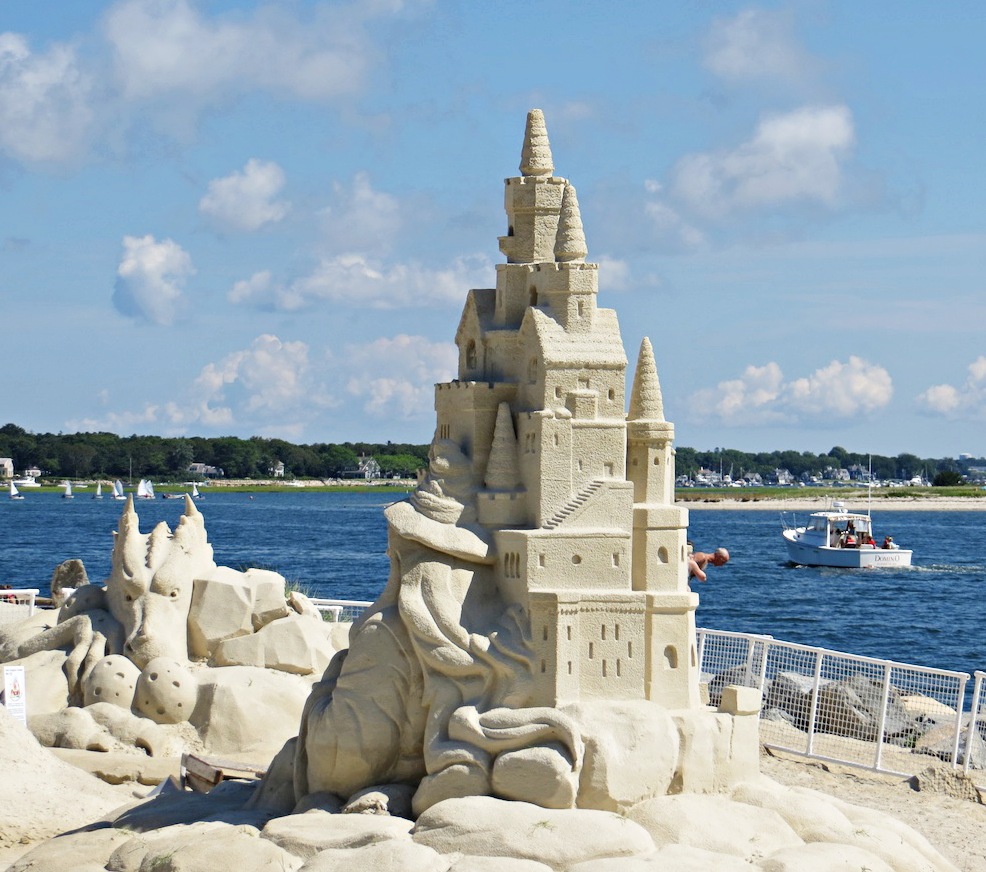
Splendid sand castle on Bass River Beach.
In addition, Yarmouth has four fresh-water beaches on town ponds.
Here's a map of all Yarmouth's beaches.
West Yarmouth Beaches
The southwestern part of Yarmouth along Nantucket Sound is mostly pure, soft, white-sand beach—simply splendid!—and most of it is open to the public, with good facilities.
Here are West Yarmouth's beaches, from west to east:
Bay View Beach
Small but nice no-fee beach with a small unlocked parking lot at the southern end of Bayview Street. Portable toilets in summer, no other services.
Colonial Acres Beach
Small no-fee sea beach with a small unlocked parking lot at the southern end of Standish Way. Portable toilets in summer, no other services.
Englewood Beach
This small sea beach at the southern end of Berry Avenue has a small parking lot, but no other services.
Sandy Pond
This small freshwater beach on the shore of Little Sandy Pond in the Sandy Pond Recreation Area off Buck Island Road has advantages: if not everyone in your group wants to swim, the forested Recreation Area has softball and soccer fields, tennis and basketball courts, a picnic area and playground, and public toilets.
Seagull Beach
Yarmouth's largest beach, down South Sea Street, has a big parking lot (locked at night), a large bathhouse with showers, and food stands.
South Yarmouth Beaches
Bass River (Smugglers) Beach
Bass River is perhaps Yarmouth's most splendid beach on Nantucket Sound, the eastern end of a broad stretch of fine white sand that stretches for miles toward the southwest.
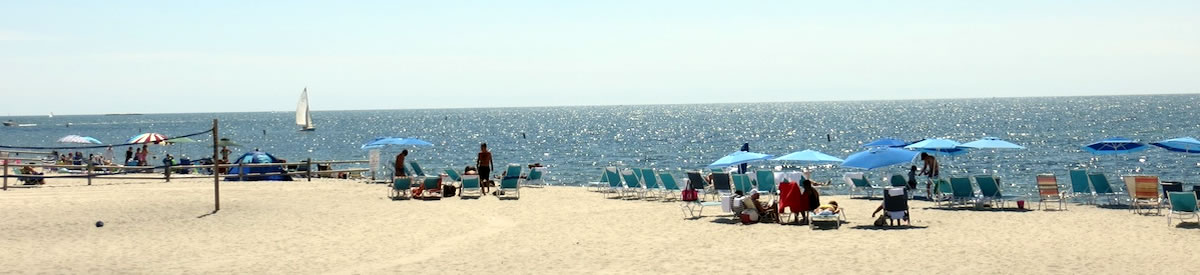
Bass River (Smugglers) Beach, South Yarmouth, Cape Cod MA.
Long Pond (Wings Grove)
The freshwater beach on forested Long Pond north of MA Route 28 has a small playground, a basketball court, and portable toilets.
Flax Pond
The beach and recreation area at freshwater Flax Pond, south of US 6 (the Mid-Cape Highway), has a baseball field, volleyball and basketball courts, public toilets, and a picnic area.
Parker's River Beach
The southwestern continuation of Bass River Beach, Parker's River Beach also has a fairly large parking lot (locked at night), a bathhouse and showers, food stands, and a children's playground. Follow Seaview Avenue south to the beach, then South Shore Drive northeast to the parking lot.
Sea View Beach
The southwestern continuation of Parker's River Beach, Sea View has a smaller parking lot than Parker's (locked at night), and fewer services: a picnic area and portable toilets in summer.
South Middle Beach
A small residents-only beach open to Town of Yarmoith property-owners and -renters.
Wilbur Park Beach
Narrow Wilbur Park Beach, on the Bass River just south of Highbank Road, has no services except picnic tables. The smal parking lot is locked at night.
Windmill Beach
Off River Street on the Bass River, Windmill Beach has—surprise!—a windmill, which is its greatest asset. The small parking lot is locked at night.
Yarmouth Port Beaches
Only one saltwater and one freshwater beach to speak of in northern Yarmouth, but the water is warmer and the crowds thinner because it's on Cape Cod Bay:
Bass Hole (Grey's) Beach
This unlocked no-fee beach off the northern end of Center Street has toilets and a picnic area.
Dennis Pond
The small freshwater beach on Dennis Pond off Summer Street is a pleasure with the little ones.
Historic Yarmouth
Drive along MA Route 6A through the northern reaches of the town of Yarmouth (map) and you'll pass the Old Yarmouth Inn and, just east of it, the Parnassus Book Service, in a building which started life as a church and later became a general store. Now the stock is books, including old and rare. No charge for browsing.
Across the street from Parnassus is Hallett's Store, a revered Yarmouth landmark, having been here, and in operation, since 1889. Drop in for breakfast, a light meal, ice cream, or a Cape Cod souvenir.
Just a minute's walk east is the US Post Office, and behind it are the Botanic Trails of the Historical Society of Old Yarmouth. The trails are open during daylight hours seven days a week year round.
Note that these are not formal "botanical gardens," but rather trails through particularly beautiful wild areas of Yarmouth's land and marshes. Local flowers and trees, plants, and geological features are on view, and maps and trail booklets available at the gatehouse where you pay admission will tell you all about what there is to see.
Near the Botanic Trails is the Captain Bangs Hallet House Museum, built as a residence by a captain in the China trade. The house's history is as interesting as its Greek Revival façade. The devoted caretaker will fill you in on the confusing chronicle of the house's various owners and reconstructions.
The Winslow Crocker House on MA 6A is owned and maintained by Historic New England. The rooms in this Georgian house are furnished with 17th- to 19th-century collections.
On the way to Bass Hole (Grey's) Beach (at the end of Centre Street—turn north off MA Route 6A), note the cemetery on your left with graves dating from 1639.
Where to Stay in Yarmouth
Starting from the Hyannis town line in the west and stretching along MA Route 28 to the Dennis town line in the east, Yarmouth has a variety of hotels, motels and inns constituting the greatest concentration of lodgings on Cape Cod.
Yarmouth Beach Hotels
In addition, a half-dozen hotels are located on or near South Yarmouth's Nantucket Sound beaches. The greatest concentration is at the eastern end of Yarmouth's Nantucket Sound shore at Bass River Beach. Here, Red Jacket operates several large hotel and rental condominium complexes that are perfectly positioned and finely maintained.
The 3-star, 125-room Red Jacket Riviera Beach Resort, located right on the beach, with indoor and outdoor swimming pools as well. The neighboring 3-star, 113-room Blue Water on the Ocean is similar.
The 3-star, 68-room Ocean Club has rental units.
The 3-star, 35-room Surf & Sand Beach Motel is smaller, but still quite nice, right on the beach, and lower in price.
MA Route 28 Hotels & Motels
If you don't mind driving a few minutes to get to the beach, you can save lot of money by staying in one of the comfortable hotels/motels on MA Route 28 in Yarmouth. For example, the 3-star, 116-room Cape Point Hotel has indoor and outdoor pools, sauna, hot tub, fitness center, game room, café, and sports lounge, at about half the cost of a hotel 2 miles (3 km) away on the beach.
The 100-room Mariner Motor Lodge rates 3 stars, yet costs even less—and it still offers indoor and outdoor swimming pools, sauna, picnic area with barbecue, and mini-golf course.
Yarmouth Port Inns
In northern Yarmouth, in the village of Yarmouth Port near Bass Hole (Grey's) Beach on Cape Cod Bay, are several excellent country inns, finest of which is the 4-star, 9-room Inn at Cape Cod, offering full breakfast daily. Some rooms have fireplaces and spa tubs.
Also charming and more economical is the 4-star, 5-room One Center Street Inn just a mile (1.6 km) to the east along MA Route 6A.
For even more choices, use this handy Hotel Search Box to check locations, room rates, and availability of Yarmouth hotels, resorts, motels & inns:
Nantucket
Fast ferries zoom across Nantucket Sound from Hyannis to the famous whalers' island "Thirty miles at sea." Others go from New Bedford, avoiding the traffic jams on the Cape Cod Canal bridges. More...
Martha's Vineyard
Ferries from Woods Hole and Falmouth take you to the island of Martha's Vineyard, and an Inter-Island ferry service can get you right from Martha's Vineyard to Nantucket, if you wish. More...
Cape Cod Canal
The man-made maritime short-cut between Boston and New York City was built to the delight of 20th-century ship captains and the consternation of 21st-century motorists.
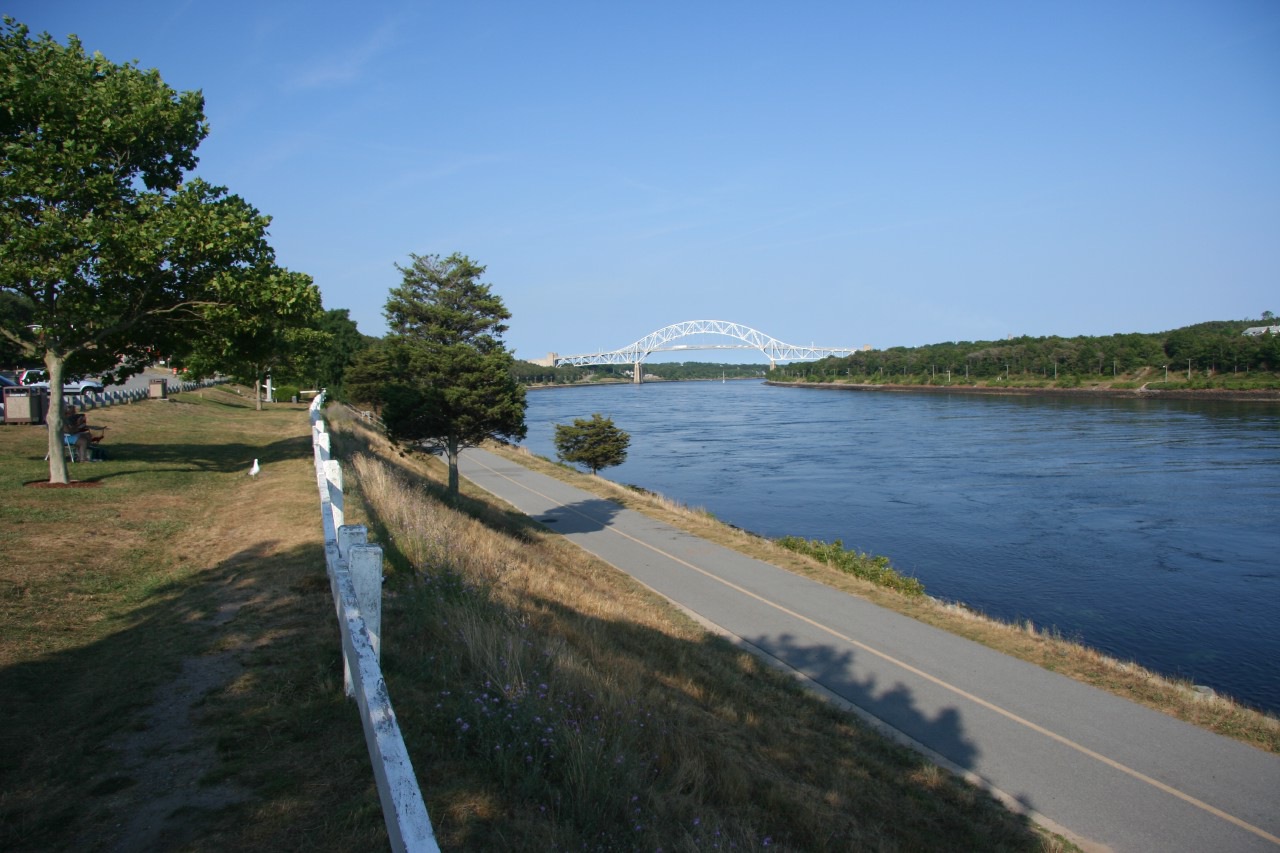
Cape Cod Canal looking NE to Sagamore Bridge from US Route 6.
For centuries, mariners sailing between Boston and ports to the south had to circumnavigate Cape Cod, a long and tedious voyage (map).
In 1909, the US government undertook construction of the Cape Cod Canal, a broad waterway connecting Cape Cod Bay and Buzzards Bay.
By 1914 the new maritime road was open, and ships could sail (or steam) from Boston to New Bedford, Providence, New London and New York City in far less time, in far greater safety.
During the 1930s, the government built the two graceful bridges across the canal at Sagamore to the northeast and Bourne to the southwest, and the project was complete.
Within a few decades, the canal was far less important, as the bulk of coastal transport was by cars and trucks on modern highways, and airplanes in the sky above.
However, vehicular traffic to Cape Cod during the busy summer tourist season has increased to the point where the two 1930s bridges are woefully inadequate to meet the demands of the flood of cars. You can wait a frustratingly long time to cross the bridge at heavy-traffic times (Friday evening and Saturday morning going onto the cape, Sunday evening going off the cape).
If you see a bumpr sticker announcing the Cape Cod Canal Tunnel, you should know that this is only a dream—a mythical engineering feat that will alleviate all of Cape Cod's traffic woes. No such tunnel has been built, nor is it likely to be, and if it were, it would only increase congestion on the Cape. It's a joke!
Today the Cape Cod Canal is a convenience for recreational boaters, a short cut for some larger ships, and a beautiful man-made waterway with several small parks along its banks, perfect for enjoying a picnic on a summer evening, and sunset views.
As for the small campaign to fill in the Cape Cod Canal so that highways can easily extend to the Cape, it is a formula for assuring that every street on the Cape becomes part of New England's largest traffic jam.
Thoreau on Cape Cod
Cape Cod was formed by glacial action and was given its name by an early (1602) visitor to the New World, Bartholomew Gosnold. For the first three centuries after its naming it was sparsely populated by fishing families.
"The time must come when [Cape Cod] will be a place of resort for those New Englanders who really wish to visit the seaside. At present it is wholly unknown to the fashionable world...." wrote Henry David Thoreau in his book Cape Cod, published in 1865.
Cape Cod didn't stay "unknown to the fashionable world" for long. It now draws six million visitors annually from across the country and around the world.